JSU's MSN with a Nursing Education concentration: one teaching practicum, two population health practicums
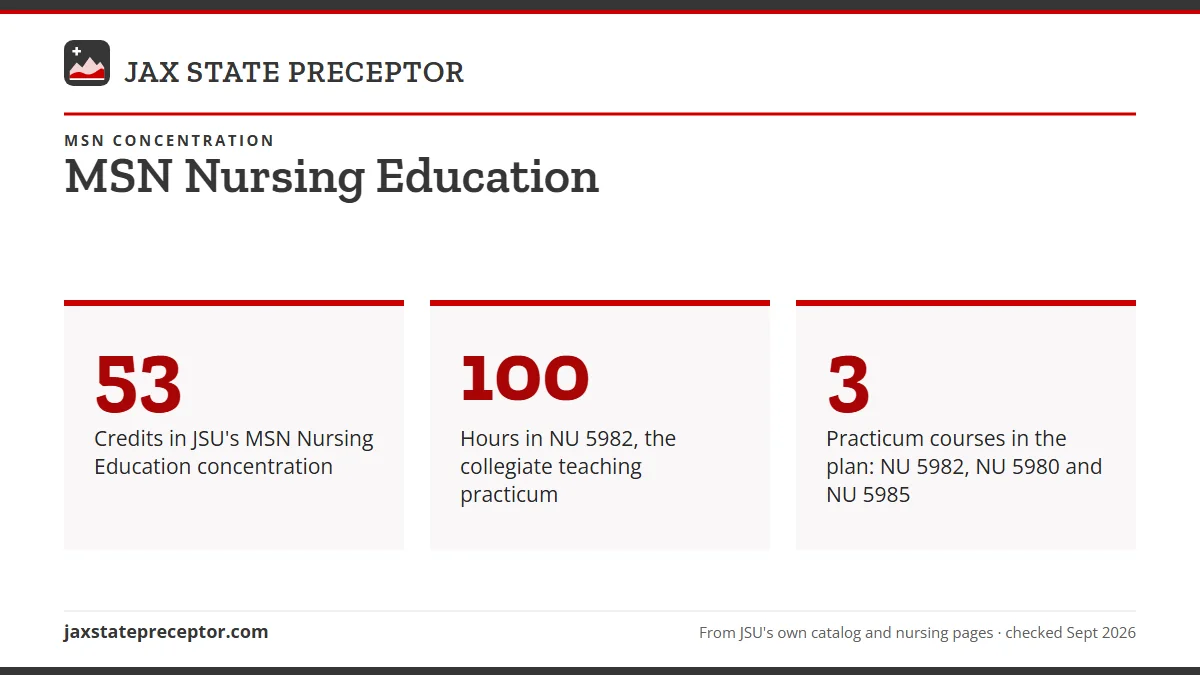
JSU's Nursing Education concentration extends the Population Health MSN to 53 credits by adding five courses on collegiate teaching, one of them a 100-hour teaching practicum. On JSU's sample plan it takes seven semesters and keeps both 254-hour population health practicums. That means three practicum courses to plan for, and this page shows when each one arrives.
Get your placement plan
Tell us your JSU program and where you live. A placement advisor replies with the preceptor and site options that fit your JSU course.
How the concentration fits the MSN
In JSU's 2026-27 catalog the program appears as Population Health, Nursing Education (MSN). It is the Population Health MSN with a teaching strand added, so admission, start terms and the core courses are shared, and the concentration grows the plan from 38 credits to 53.
The added strand is five courses in collegiate nursing education: NU 5890 Developing Instruction Programs in Collegiate Nursing Education, NU 5893 Issues and Trends in Collegiate Nursing Education, NU 5891 Teaching, Learning, and Evaluation in Collegiate Nursing Programs, NU 5894 Introduction to Instructional Design and Online Teaching, and NU 5982 Practicum in Collegiate Nursing Education.
JSU's page for the concentration describes "100% online courses with required practicum" and says students "participate in applied learning through a teaching practicum in their settings of choice." Other JSU program pages mention possible on-campus events, so confirm any campus dates at orientation.
Seven semesters on the sample plan
JSU's web page lays the concentration out over seven semesters from a fall start. Individual plans shift with your entry term and course load.
| Semester | Courses (credits) |
|---|---|
| 1, Fall | NU 5101 (0), NU 5204 (2), NU 5218 (3), NU 5890 (3) |
| 2, Spring | NU 5227 (3), NU 5744 (3), NU 5893 (3) |
| 3, Summer | NU 5242 (3), NU 5722 (3), NU 5891 (3) |
| 4, Fall | NU 5207 (3), NU 5220 (3) |
| 5, Spring | NU 5213 (3), NU 5894 (3), NU 5982 teaching practicum (3) |
| 6, Summer | NU 5980 Population Health I (6, practicum) |
| 7, Fall | NU 5985 Population Health II (6, practicum) |
The teaching courses lead, one per semester through the first summer. Advanced health assessment, pharmacology and pathophysiology move to semesters four and five, and because NU 5980 needs assessment and pathophysiology first, both population health practicums wait until the final summer and fall. The practicum load is back-weighted: three practicum courses in the last three semesters, one after another.
NU 5982: 100 hours of collegiate teaching
NU 5982 is a three-credit course that includes a 100-hour practicum. On JSU's sample plan it sits in the fifth semester, a spring, beside NU 5894 and NU 5213, after the three core teaching courses. The catalog does not list a fixed term for it, so your plan of study is the place to confirm timing.
JSU frames the practicum around the student. Its certificate page describes a practicum built on student needs and planned together with the student at a place that suits them, and the concentration page speaks of settings of choice. JSU does not publish qualifications for the teaching mentor, so your course faculty are the ones who confirm what kind of setting and educator the course accepts.
The NU 5982 page covers the course in more depth, including the questions worth settling with faculty before the spring.
The teaching practicum does not replace the population health practicums: this concentration requires NU 5982, NU 5980 and NU 5985.
Population Health I and II close the plan
The last two semesters belong to population health. NU 5980 Population Health I runs in semester six, the summer, and NU 5985 Population Health II in semester seven, the fall. Each carries 254 practicum hours and runs in just that one term of the year. Since NU 5985 requires NU 5980 first, missing the summer course can push both back by a year.
These practicums ask for a different kind of setting from the teaching practicum. A collegiate nursing program is the natural home for NU 5982; the population health courses call for organizations whose work reaches communities or groups. Planning both early avoids a scramble in the final year, when the teaching practicum in spring hands straight over to the summer course. The population health practicums page describes the two courses and their prerequisites.
The certificate route and progression rules
JSU also offers a 15-credit Graduate Certificate in Nursing Education made of the same five education courses, NU 5982 included. It asks for a BSN and a current unencumbered RN license, and its credits apply toward this MSN concentration, so a certificate graduate can continue into the MSN without repeating the teaching strand. The nursing education certificate page covers the certificate on its own terms.
Admission matches the plain MSN: a 3.0 GPA (a 2.5 may earn conditional entry), a current unencumbered RN license and no GRE or MAT. Deadlines fall on July 1 for fall, November 1 for spring and April 1 for summer, with late files considered while seats remain, and applicants from other states are asked to reach the School of Nursing before they apply.
Progress in the MSN runs on the graduate rules: B or better in prior coursework before each clinical course, one retake allowed for a single C-level grade, and loss of eligibility past 3 credits of C. The six-year MSN time limit applies, there is no comprehensive exam, and up to 12 transfer hours can count.
How we prepare both kinds of practicum
Whatever part JSU plays in your placements, we find settings that meet its rules for all three practicum courses. For NU 5982 we look for a collegiate nursing program and an experienced nurse educator near you whose teaching fits the course. For NU 5980 and NU 5985 we look for a population-focused organization that can host you across the summer and fall.
We gather each mentor's or preceptor's credentials and each organization's details for any agreement, and before anyone is contacted we make sure JSU has approved your malpractice coverage and your CastleBranch file is current, as described on the CastleBranch page. If a setting withdraws, your placement advisor starts the replacement search without delay.
Approval of each setting rests with JSU's faculty, and our part is sending them a file that is complete and right on the first pass. Use the form below to tell us when you start and where you live.
Questions JSU students ask
Is JSU's MSN in Nursing Education fully online?
JSU describes the concentration's courses as fully online with a required practicum, and the MSN overview uses the same wording. Some JSU program pages add that on-campus events such as orientation may be required, and JSU does not post a count of campus days. Ask at orientation, and remember that the three practicum courses happen in real settings.
Can I do my JSU teaching practicum at my own workplace?
JSU's pages describe the teaching practicum as planned with you in a location that suits you, but they publish no rule on using your own employer. Ask your NU 5982 course faculty before committing to a setting where you work. JSU's graduate handbook also asks you to report any change of employer during the program.
What is the difference between JSU's nursing education certificate and the MSN concentration?
The certificate is 15 credits: the five collegiate teaching courses, including the NU 5982 practicum. The MSN concentration is 53 credits and adds the population health core, advanced assessment, pathophysiology and pharmacology, research, and the two 254-hour population health practicums. Certificate credits apply toward the concentration if you continue.
How long does the Nursing Education MSN take at JSU?
JSU's sample plan runs seven semesters from a fall start, summers included, which is a little over two years. Starting in spring or summer, or studying part time, changes the sequence, and the fixed summer and fall terms of the population health practicums anchor the end. Every MSN student has six years to finish.
Who mentors students in JSU's NU 5982 teaching practicum?
JSU does not publish qualifications for the educator who hosts NU 5982, and its pages describe the practicum as planned with each student around their needs. In practice that makes your course faculty the people who confirm whether a given nurse educator and program fit. We bring them the mentor's credentials and teaching role in full, so they have what they need to decide.
Related pages
Last checked 2026-09-27
We check these pages against JSU's 2026-27 catalog, nursing handbooks, program pages and licensure disclosures. Your course faculty and your plan of study have the final word.
Whether JSU helps or you start alone, we find the preceptor.
Tell us your JSU program, your next practicum or residency and the town you train near. We find preceptors and sites that fit the course and gather what JSU's faculty need to clear them, early enough for the semester.
- Preceptors matched to the course: family practice across the lifespan, adult-gerontology acute care, DNP residencies
- License, certification and site details ready for JSU's clearance, with your CastleBranch and malpractice items in order
- Across Alabama and in Georgia, Florida, Mississippi and Tennessee
Start your placement plan
Your program, your town and your next clinical semester is all we need to begin.