Can't find a preceptor for your JSU clinical course?
A long list of unanswered calls rarely means your JSU practicum is out of reach. More often the search needs a sharper match to the course and a better order of steps. Whether or not JSU helps with your placement, we find a preceptor and site that meet its rules and prepare what JSU's faculty need to clear them.
Get your placement plan
Tell us your JSU program and where you live. A placement advisor replies with the preceptor and site options that fit your JSU course.
Why a JSU preceptor search stalls
Stalled searches tend to share a handful of causes, and none of them is a verdict on you as a student. Every JSU practicum calls for a particular patient mix and a fixed block of hours, so a clinician who would happily teach can still be the wrong fit for the course in front of you.
- The course is specific.
FNP 7877reaches pediatric, adult, obstetric and geriatric patients, while the AGACNP practicums center on acute care for late adolescents through older adults. - The load is real. Practicum III carries 250 catalog hours on both tracks, and a clinician has to fit that into one semester of clinic days.
- Hospitals add a layer. Systems that publish a process for NP students usually want a school agreement in place and a named preceptor before an application moves.
- Late starts crowd the field. Each NP practicum runs in one term a year, so a search that begins in the final weeks competes with students from other nursing programs chasing the same clinicians.
- Outreach waits on your clearance. JSU wants your malpractice coverage approved before anyone contacts a practicum or residency site, so a delay there pauses everything.
Check your side of the file first
Before another round of calls, confirm the pieces of the process that sit with you. A preceptor who says yes still needs JSU's faculty to clear the match, and your own record travels with that request.
- Malpractice coverage bought through the JSU School of Nursing, uploaded and showing as approved.
- CastleBranch items that stay current through the whole term: TB inside its 12-month window, a flu shot for the September to March season, the yearly physical, and AHA CPR for healthcare providers.
- The exact course number and hours from the 2026-27 catalog. Practicums III and IV carry more hours there than in the 2024-25 graduate handbook, so older figures can mislead a preceptor about the commitment.
- The dates of the term your practicum runs in, and the week you hope to log your first hours.
- A short written note to your course faculty, sent from your GEM account, saying your search is under way.
Every tracker item JSU names is listed in the CastleBranch guide.
Widen the search without losing the fit
A wider search works when it stays anchored to your course. Alabama's nursing education rules describe an advanced practice preceptor as an APRN, a physician or another appropriately licensed clinician focused on the right population, so a physician-led practice can suit you as well as an NP-led one, subject to your faculty's review.
Distance deserves a second look too. The clinician must hold a license valid where your hours take place, and a practice a little farther from home may have room for a student when busy metro clinics are already committed.
Northeast Alabama shows why. Calhoun, Etowah and Talladega counties carry federal primary care shortage designations for low-income residents, and several rural neighbors such as Cleburne, Randolph and Clay are designated by geography. Clinics serving those communities deserve a place on your list. Our regional guides cover Anniston and Gadsden, Birmingham and Huntsville.
How we get a stalled search moving
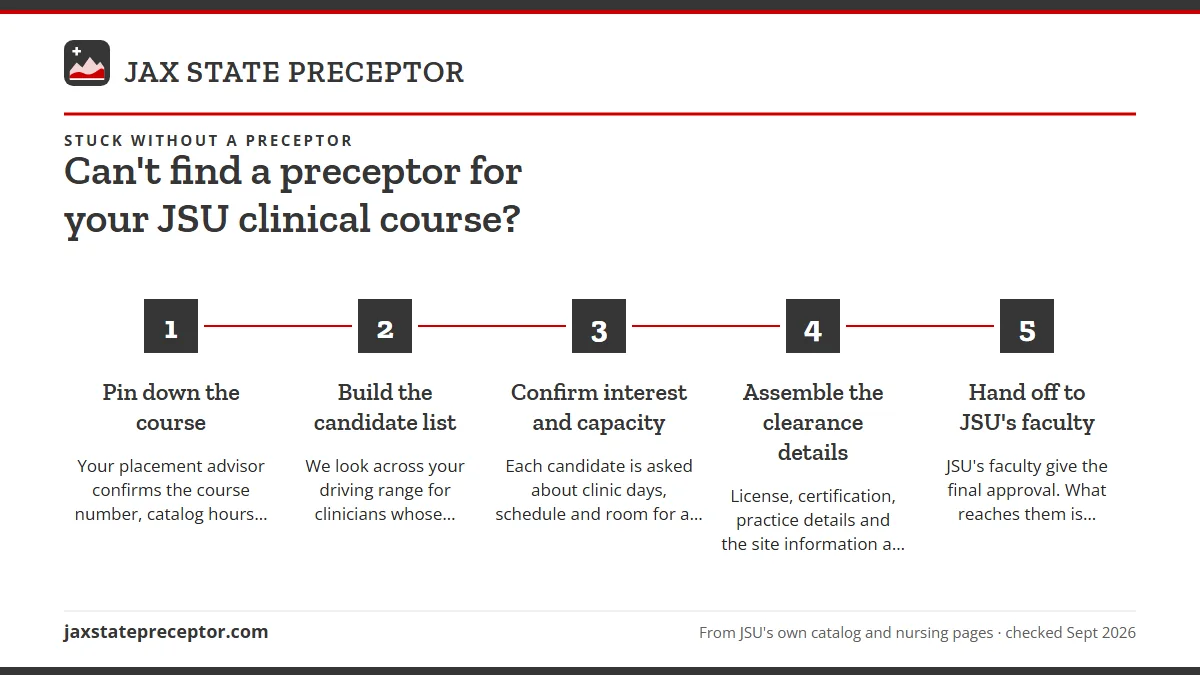
When a stalled search lands with us, we begin from your course rather than from a list of names. The work runs in this order.
- Pin down the courseYour placement advisor confirms the course number, catalog hours, term and patient population, plus the lecture course it is paired with.
- Build the candidate listWe look across your driving range for clinicians whose patients match that population, including settings you may not have tried.
- Confirm interest and capacityEach candidate is asked about clinic days, schedule and room for a student across the full hours before your name goes forward.
- Assemble the clearance detailsLicense, certification, practice details and the site information a contract needs come together in one organized file.
- Hand off to JSU's facultyJSU's faculty give the final approval. What reaches them is complete and fits JSU's rules the first time.
The full sequence, including what happens after the match, is on how it works.
A DNP residency calls for a different search
Residency preceptors are chosen for staying power. JSU's DNP timeline expects one preceptor and one clinical site to carry a student through 16 months, across DNP 8797, DNP 8798 and DNP 8799 at 210 hours each, with a quality-improvement project carried out inside that organization.
That changes the questions we ask. Beyond clinical fit, we want to know whether the preceptor expects to stay in the role, whether leadership will back a project, and whether the site can host planning and implementation meetings every semester. Most residents are matched in late May during DNP 8796, and a smaller group begins in August; the residency pairing guide explains both starts. Post-Master's DNP students follow the same residency pattern.
When the calendar is part of the problem
If the semester is close or already running, the search changes shape. Speed matters, and so does knowing the rule that raises the stakes: each NP practicum is paired with its lecture course, and not passing either one means taking both again.
For a start date only weeks away, read need a preceptor fast. If the term has begun and your log is thin, behind on clinical hours covers the options to raise with your faculty. Both guides work best once your course faculty already know where things stand.
Get your JSU malpractice coverage approved first: JSU wants it in place before any practicum or residency site is contacted, by you or by anyone searching on your behalf.
Questions JSU students ask
Is it harder to find an AGACNP preceptor than an FNP preceptor?
The two searches differ more than they compare. AGACNP practicums center on acute care, which often means hospitals and hospital-based groups, and systems with a published student process usually want a school agreement and a named preceptor first. FNP practicums fit a wider range of outpatient practices but ask for a broad patient mix, especially in FNP 7877. We plan each search around those differences.
Can I keep looking on my own while you search?
Yes, and share every lead with your advisor. Tell us which clinicians you have already contacted and what they said, so nobody is approached twice and a promising contact is followed up properly. If one of your own leads says yes, your advisor can check the fit against your course and prepare the details JSU's faculty review.
What should I tell my course faculty while I am still searching?
Keep them informed in writing through your GEM email: the course, where your search stands and the date you expect to confirm a preceptor. Faculty may have course-specific guidance on settings or timing that saves you calls. An early message also puts your effort on record if the search runs close to the start of term.
Do you help JSU MSN and teaching practicum students who are stuck?
Yes. The MSN in Population Health includes NU 5980 and NU 5985, each with 254 practicum hours, and we search out settings where population-level work fits both terms. The Nursing Education practicum, NU 5982, runs 100 hours and JSU plans it around a location that suits the student, so we look for an experienced nurse educator close to you.
Does living outside Alabama make the search harder?
It changes the rules more than the odds. JSU considers residents of Alabama, Georgia, Florida, Mississippi and Tennessee for its NP tracks, and each state treats out-of-state programs in its own way. Mississippi, for example, has a separate review body for programs placing students there. We search where you live and check that state's rules as part of the match.
Related pages
Last checked 2026-09-27
We check these pages against JSU's 2026-27 catalog, nursing handbooks, program pages and licensure disclosures. Your course faculty and your plan of study have the final word.
Whether JSU helps or you start alone, we find the preceptor.
Tell us your JSU program, your next practicum or residency and the town you train near. We find preceptors and sites that fit the course and gather what JSU's faculty need to clear them, early enough for the semester.
- Preceptors matched to the course: family practice across the lifespan, adult-gerontology acute care, DNP residencies
- License, certification and site details ready for JSU's clearance, with your CastleBranch and malpractice items in order
- Across Alabama and in Georgia, Florida, Mississippi and Tennessee
Start your placement plan
Your program, your town and your next clinical semester is all we need to begin.