Three routes to a JSU preceptor, compared
JSU nursing students reach a preceptor and clinical site through people they already know, through organizations that offer to host JSU students, or with a placement service, and many use more than one. This page sets the three routes side by side so you can weigh them against your course, your town and your calendar.
Get your placement plan
Tell us your JSU program and where you live. A placement advisor replies with the preceptor and site options that fit your JSU course.
Start with what JSU publishes
JSU's public pages describe pieces of its clinical process without spelling out who arranges each placement. The graduate handbook sets malpractice clearance as a precondition for reaching out to clinical sites, the DNP timeline describes a late-May pairing for residency students, and a 2026 JSU page invites clinical partners to offer to host NP students.
Those pieces fit more than one arrangement, and practice can vary by track and cohort. The clearest answer for your own course comes from your track's clinical coordinator or your course faculty. Whatever they tell you, the preceptor and site still have to meet JSU's rules and pass its faculty review, so the routes below differ in who does the legwork, not in the standard.
Route one: your own network
Your network is the people who already know your work: the nurse practitioners and physicians you work beside, former managers, colleagues' contacts and practices in your town. A preceptor who knows you can mean an easy first conversation and a schedule built around your shifts.
This route asks for your time and some care about fit. The clinician has to match the course's population, so a family practice that sees few children or pregnant patients may struggle to cover FNP 7877, which spans pediatric, adult, obstetric and geriatric patients. If you make contact yourself, JSU's handbook wants your malpractice coverage approved first. Precepting where you work raises its own questions, covered in the workplace clinicals guide.
Route two: JSU's clinical partners
JSU's Request a JSU DNP Student page, added in 2026, asks outside organizations to welcome its FNP and ANP students or sponsor a DNP quality-improvement project. The sign-up form collects how many students an organization wants and, for NP students, the hours or semesters it could offer. The clinical partner requests guide walks through the page.
What JSU's pages leave open is how those offers reach individual students and how many partners sit near a given town. Health systems add their own terms too. Across the Georgia line, Atrium Health Floyd names JSU among the schools with an NP agreement, has frozen new school agreements, sets a three-month minimum lead time for applications and wants one of its own clinicians to agree to precept before a student applies. Ask your coordinator whether partner sites exist in your area.
Route three: a placement service
A placement service does the search and the paperwork with you. The best ones start from your JSU course rather than a generic list, check your CastleBranch record and malpractice approval before contacting anyone, and hand JSU's faculty a complete file on the preceptor and site.
That is how we work. We search near where you live for a clinician whose patients match your course, confirm the preceptor's schedule and capacity, gather the license, certification and site details JSU reviews, and stay on call through the semester. For a DNP residency, we screen for a preceptor and organization prepared to stay with you for all 16 months. The guide to choosing a placement service lists the standards to hold any service to.
The routes side by side
Most students weigh the same four questions. Here is how each route answers them.
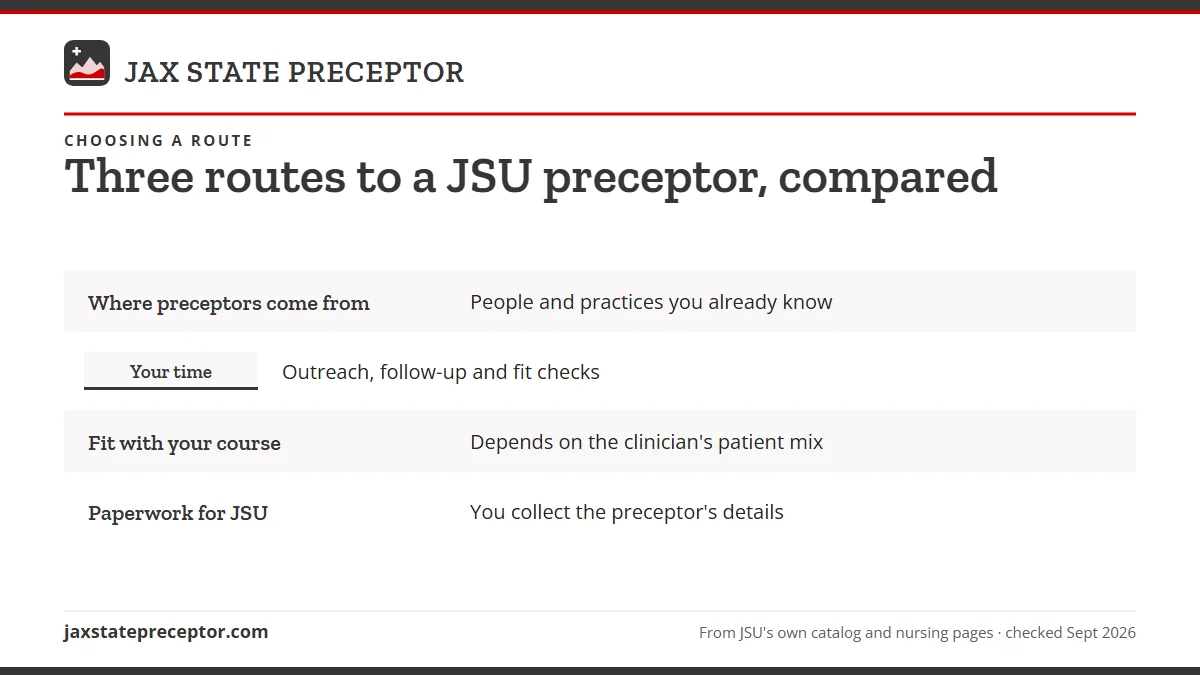
| Question | Your own network | JSU's clinical partners | A placement service |
|---|---|---|---|
| Where preceptors come from | People and practices you already know | Organizations that offer to host JSU students | A search built around your course and town |
| Your time | Outreach, follow-up and fit checks | Asking your coordinator what is available | Sharing your details and keeping CastleBranch current |
| Fit with your course | Depends on the clinician's patient mix | Depends on what partners offer near you | Screened against your course before your name goes forward |
| Paperwork for JSU | You collect the preceptor's details | Follows JSU's own process | Prepared and checked for you |
Read the table as a starting point. The best answer can change from one semester to the next, since FNP 7869 in spring and FNP 7875 in fall may call for different clinicians.
Questions that point you to a route
Your answers to these usually make the choice clear, and combining routes is common, such as a partner site for one course and a service-matched preceptor for the next.
- How many weeks remain before your next practicum or residency begins?
- Do clinicians near you see the populations your course names?
- Does your employer allow students on site, and does JSU accept it for your course?
- For a DNP residency, can the site commit to one preceptor for 16 months?
- Is your malpractice coverage approved in CastleBranch yet?
- What has your track's clinical coordinator said about placements for your cohort?
Whichever route you lean toward, we can run the whole search or fill the gaps around what you already have. The title for each JSU contact is in the clinical roles guide.
Questions JSU students ask
Can I use my own contacts and a placement service together?
Yes, and combining them is often the most practical plan. You might have a strong preceptor for one practicum and need help with the next, or want a second option ready while a colleague thinks it over. Tell your placement advisor who you have already approached so the search covers what is still open and nobody is contacted twice.
Does JSU publish a list of sites it has agreements with?
Not on its public pages. JSU's DNP timeline mentions contract paperwork during DNP 8796, but who signs site agreements, how long they take and whether a list exists are left unpublished. Your track's clinical coordinator is the person to ask, and some health systems publish the schools they hold agreements with.
Is a JSU partner site better than one found another way?
Neither is better by default. A partner that has offered to host JSU students may already know what to expect, while a site you or a service find may sit closer to home or match your course's population more closely. JSU's faculty review each one against the same rules.
Do DNP students choose a route differently?
Often. JSU's residency runs 16 months with one preceptor and one site throughout, so commitment matters as much as convenience, and the site also hosts your quality-improvement project. The May and August start options are explained in the residency pairing guide.
Does using a placement service change what JSU requires of me?
No. Your CastleBranch record, your JSU malpractice coverage and your coursework stay the same, and JSU's faculty still approve the preceptor and site. A service changes who runs the search and assembles the paperwork. The how it works page shows each step we take.
Related pages
Last checked 2026-09-27
We check these pages against JSU's 2026-27 catalog, nursing handbooks, program pages and licensure disclosures. Your course faculty and your plan of study have the final word.
Whether JSU helps or you start alone, we find the preceptor.
Tell us your JSU program, your next practicum or residency and the town you train near. We find preceptors and sites that fit the course and gather what JSU's faculty need to clear them, early enough for the semester.
- Preceptors matched to the course: family practice across the lifespan, adult-gerontology acute care, DNP residencies
- License, certification and site details ready for JSU's clearance, with your CastleBranch and malpractice items in order
- Across Alabama and in Georgia, Florida, Mississippi and Tennessee
Start your placement plan
Your program, your town and your next clinical semester is all we need to begin.