Clinical hours at JSU, program by program
Jacksonville State University sets clinical hours one course at a time, and the 2026-27 catalog holds the current figures. The planner below lays out each program's clinical courses with their hours, the kind of preceptor each needs and when to start looking. The sections after it cover what the planner leaves out: programs with no published hours, JSU's conflicting totals, and how a term's load shapes the preceptor you need.
Get your placement plan
Tell us your JSU program and where you live. A placement advisor replies with the preceptor and site options that fit your JSU course.
Pick your JSU program
Your clinical courses and hours, who can precept you, where, and when to start looking. From JSU's own catalog and nursing pages.
- Who precepts
- A licensed preceptor fit for family practice across the lifespan, at a site JSU's faculty clear
- Where
- Near home, in Alabama or one of the four other states the NP tracks accept
- Start looking
- Practicum I runs in spring only, in the second year of study
- Who precepts
- An acute care preceptor for late adolescent, adult and older adult patients
- Where
- Hospital and acute care settings near home
- Start looking
- Spring of the second year, then four semesters in a row
- Who precepts
- One preceptor who can stay with your project for the whole residency
- Where
- A consistent clinical site for 16 months
- Start looking
- Pairing in late May during DNP 8796, or a smaller August track
- Who precepts
- A population health or public health leader who can host your practicum
- Where
- Community, public health and health system settings near you
- Start looking
- NU 5980 in summer, NU 5985 the following fall
- Who precepts
- An experienced nurse educator in a collegiate program
- Where
- A school of nursing or teaching setting convenient for you
- Start looking
- NU 5982 in the fifth semester on JSU's sample plan
Reading the planner
Each tab in the planner is one program family: FNP, AGACNP, the DNP residency, the MSN in Population Health and the Nursing Education route. Inside a tab, the clinical courses appear in the order you take them, each with the hour figure JSU's 2026-27 catalog prints for it. Every course tag opens the guide for that course.
Under the courses sit three short answers: who can precept you, what kind of setting fits, and when to begin the search. Where JSU's own documents disagree, the tab says so in its label. The AGACNP tab, for example, notes that the plans of study give ANP 7869 110 hours while the catalog gives 70.
One thing the planner leaves off on purpose is a program total for the two nurse practitioner tracks. JSU's web pages, catalog and course hours each point to a different BSN-DNP figure, so the planner shows the course numbers you can act on and leaves the totals question to a page of its own.
Why the course figure is the one to plan around
The catalog attaches an hour count to each practicum and residency course, and that is the figure your course faculty works from inside a given term. A program total is a sum across two or more years; the course figure is what you need to finish between the first day of class and the grades deadline.
At the program level, JSU's sources for the BSN-DNP disagree: the track pages print one number, the catalog's graduation rule another, and the catalog's own course hours add up to neither. The BSN-DNP clinical hours guide sets the three side by side and explains where each seems to come from.
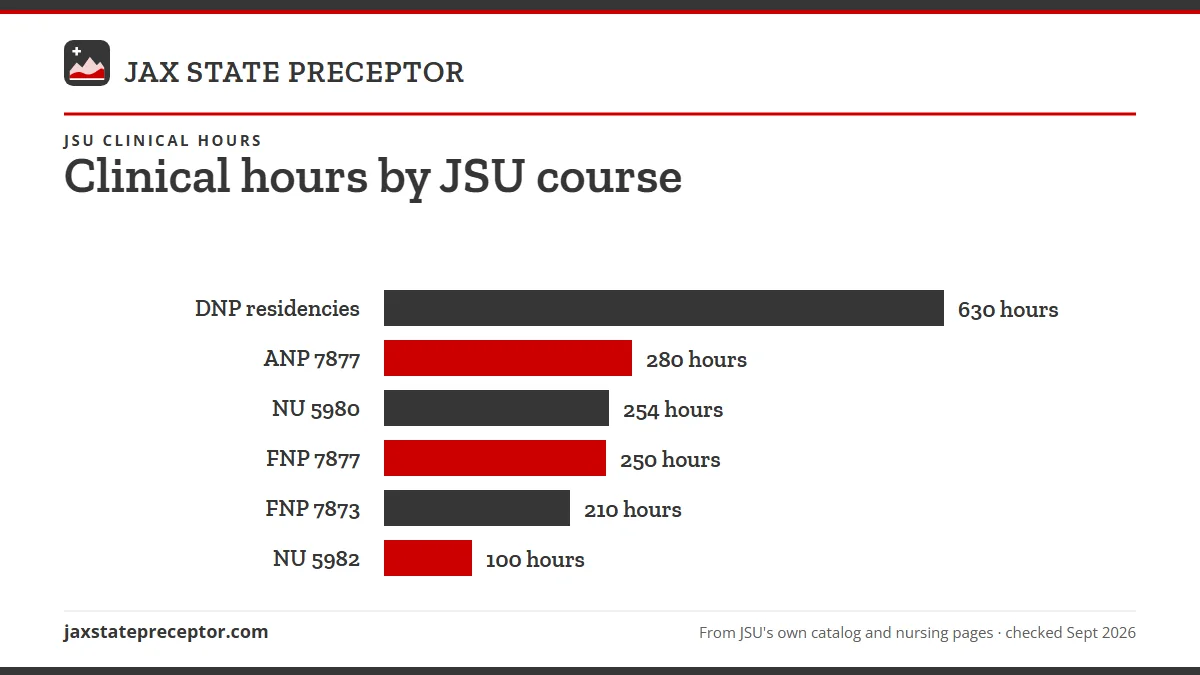
The graduate handbook adds a further wrinkle. The newest edition on JSU's site is 2024-25, written before the catalog renumbered courses and raised some practicum hours; it lists 210 hours for the third and fourth NP practicums, where the 2026-27 catalog prints 250 or 280. When two JSU documents differ, read the current catalog first and take the question to your course faculty.
Programs the planner does not break out
Several JSU programs share courses with a planner tab or publish no hour figures at all. This table covers them, using the 2026-27 catalog.
| Program | Clinical course | Hours JSU publishes |
|---|---|---|
| MSN, Emergency Management concentration | NU 5980 and NU 5985 | 254 in each; the EM courses carry none |
| Graduate Certificate in Nursing Education | NU 5982 | 100-hour teaching practicum |
| Post-Master's DNP applicants under 500 MSN hours | NU 5841 Advanced Experiential Clinical Course | 100 to 500, set by a gap analysis |
| STEP RN-BSN | NU 456 Population-Based Health Care | Not published |
| Traditional BSN | NU 311 through the NU 428 preceptor practicum | Not published per course |
| Graduate Certificate, Emergency Preparedness Nursing Coordinator | None | No practicum in its five courses |
Where JSU publishes no hour figure, the course faculty set the requirement at the start of the term. The STEP catalog entry describes NU 456 clinical experiences as designed around each RN's learning needs, which is why no fixed number appears there. For the pre-DNP course, see the NU 5841 guide.
How each term's load shapes the preceptor you need
The hour load changes from term to term, and a preceptor who suits one course may not have room for the next. In the FNP track, Practicum I asks for 120 hours in spring, Practicum II for 210 in the shorter summer term, then 250 in each of the last two practicums. The acute care track climbs from 70 to 280. The FNP practicum guide and its AGACNP companion take each of those courses in turn.
The DNP residency works differently. Its three courses carry 210 hours each, but JSU asks for one preceptor and one clinical site across roughly 16 months, so the question is less about a single term's capacity and more about whether that person and site can stay with your project through to the July results. The DNP residency hours guide walks through that commitment.
Before any of this, check which term your first clinical course falls in. The first clinical course guide maps it for every JSU program.
What counts, and who confirms it
JSU's track pages say NP clinical hours blend simulated practice with hands-on patient care. Beyond that line, the public pages say little about which activities count toward a particular course, how simulation is capped, or whether hours at your own workplace are accepted. Those answers come from the course faculty, and the guide to what counts lists the questions worth asking first.
For recording hours, JSU's public pages point to no particular tool. CastleBranch, the single vendor JSU does name, stores compliance paperwork. How you record hours for a course is set out once the course opens in Canvas, so keep your own copy of every entry as well.
Alabama's nursing education rules also expect programs to keep hour records that satisfy the national certification bodies, one more reason to record carefully from your first shift.
Why JSU students choose Jax State Preceptor for their hours
Whatever part JSU plays in your placement, our job stays constant: a clinician and a clinic matched to your course, its hour count and its semester. Every match starts from the hour figure in the 2026-27 catalog, and before anyone commits we check that the clinician has enough open clinic days to carry that load between the first day of class and finals.
Clearance paperwork gets built early. We collect the clinician's licensure, board certification and practice setting, the clinic's information for a contract, and we confirm your CastleBranch tracker and malpractice approval are settled before a single site is approached. JSU's faculty sign off on each match; our part is handing them a file with nothing missing.
Should a clinician pull out partway through a semester, the hunt for a new one begins at once, since every lost week eats into your hours. Read how our process runs, then send your course number and term through the request form on this page.
Questions JSU students ask
How many clinical hours is JSU's FNP program?
JSU does not give one settled figure. Its FNP web page says 700, the 2026-27 catalog's graduation rule says 1330, and the catalog's course hours (120, 210, 250 and 250, then three 210-hour residencies) add up to neither. Plan each term by the course figure and ask your faculty how the program total is checked.
How many practicum hours are in JSU's MSN in Population Health?
The catalog lists 254 practicum hours for NU 5980 Population Health I, a summer-only course, and 254 for NU 5985 Population Health II, which runs in fall only. Both concentrations take the same pair, and the Nursing Education concentration adds the 100-hour NU 5982 teaching practicum. JSU does not print a combined figure.
Does the Post-Master's DNP count my MSN clinical hours?
Your MSN hours matter at admission, not inside the program. JSU admits Post-Master's applicants whose MSN validates 500 clinical practicum hours. Applicants with fewer are admitted conditionally and take NU 5841, with hours set by a gap analysis. The 630 residency hours are then earned in the three DNP residency courses.
Why are there no clinical hours listed for JSU's STEP RN-BSN?
The catalog gives NU 456 Population-Based Health Care six credits and says its clinical experiences are designed around each RN's individual learning needs, so no fixed hour count is published. Your course faculty set the expectations when the course opens, usually in the summer term of the catalog's sample plan.
Where do I confirm my hour requirement for this semester?
Start with the course entry in the 2026-27 JSU catalog, then check the course in Canvas as soon as JSU opens it at the start of the semester. Anything the catalog and course materials leave open, such as how simulation counts, goes to your course faculty before you log hours.
Related pages
Last checked 2026-09-27
We check these pages against JSU's 2026-27 catalog, nursing handbooks, program pages and licensure disclosures. Your course faculty and your plan of study have the final word.
Whether JSU helps or you start alone, we find the preceptor.
Tell us your JSU program, your next practicum or residency and the town you train near. We find preceptors and sites that fit the course and gather what JSU's faculty need to clear them, early enough for the semester.
- Preceptors matched to the course: family practice across the lifespan, adult-gerontology acute care, DNP residencies
- License, certification and site details ready for JSU's clearance, with your CastleBranch and malpractice items in order
- Across Alabama and in Georgia, Florida, Mississippi and Tennessee
Start your placement plan
Your program, your town and your next clinical semester is all we need to begin.