JSU's BSN-DNP Family Nurse Practitioner track, from first course to residency
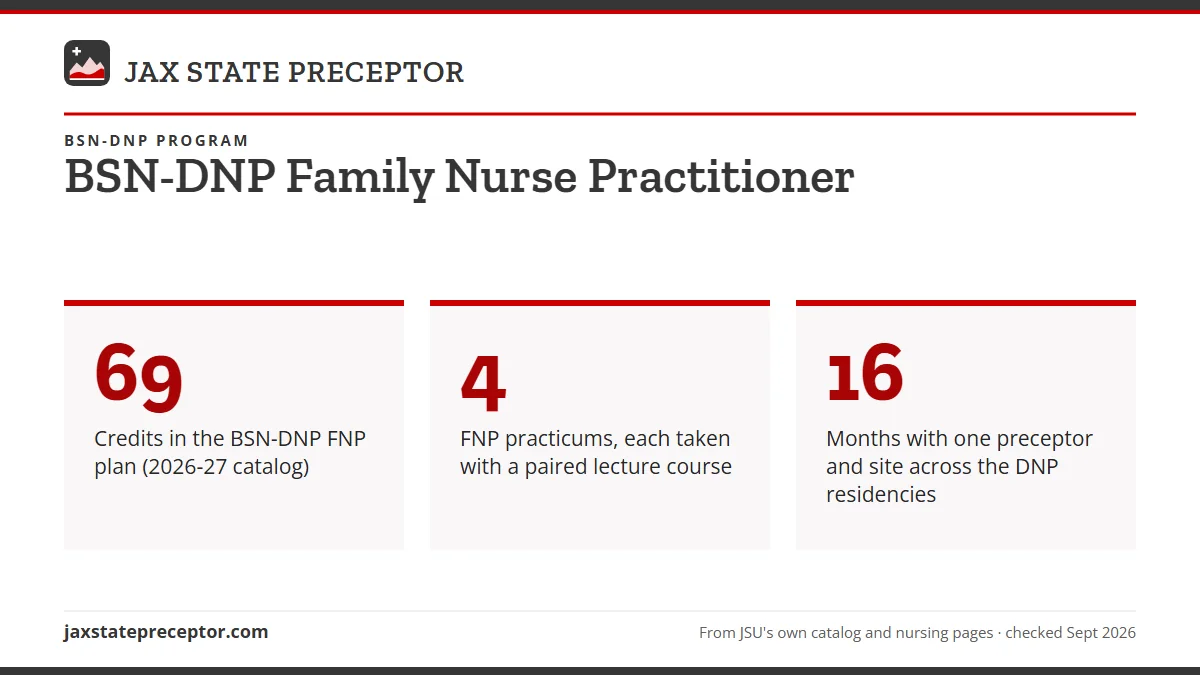
JSU prepares family nurse practitioners inside a 69-credit BSN-DNP plan that runs online, with a few on-campus events. You complete four FNP practicums in four straight semesters, receive an MSN after the fourth, then finish three DNP residencies with one preceptor and site. This page maps that path and shows where our placement work fits into it.
Get your placement plan
Tell us your JSU program and where you live. A placement advisor replies with the preceptor and site options that fit your JSU course.
The FNP track in brief
The 2026-27 catalog lists this program as Family Nurse Practitioner (Doctor of Nursing Practice), a 69-credit plan of study delivered online. JSU's track page adds that some on-campus events may be required, naming orientation, on-site simulated learning and the presentation of scholarly projects. JSU's online and graduate academic services director issues each admitted student an individual plan of study.
A fall entry follows a 12-semester plan, from Fall of Year 1 through Summer of Year 4. A spring entry compresses the same work into 11 semesters. JSU's web pages post a May 1 fall deadline and an October 1 spring deadline, yet the catalog's admission text says applicants are considered for fall only. If a spring start matters to you, ask the program coordinator which reading applies to your cycle.
Admission asks for a 3.0 GPA (in the BSN or the last 60 hours), a 2.5 science GPA and an unencumbered RN license. JSU's nurse practitioner tracks consider applicants who live in five states, Alabama, Georgia, Florida, Mississippi and Tennessee, a rule the admission states page unpacks, including what it means for where clinicals happen.
Year one and the gate before Practicum I
The opening semesters are shared doctoral and advanced practice coursework: evidence-based practice and quality improvement, clinical prevention and population health, organizational leadership, health policy and finance, plus a zero-credit online orientation, NU 8002. None of these courses carries clinical hours, which makes them the right window for planning the clinical years ahead.
Three courses stand between you and patient care: NU 7007 Advanced Health Assessment, NU 7013 Physio-Pathological Basis of Advanced Nursing and NU 7020 Pharmacology for Advanced Practice Nurses. The catalog makes all three prerequisites for the first FNP lecture and practicum. The 2024-25 graduate handbook adds a clock, too: these courses must sit within two years of the start of NP specialty coursework, so a long pause before Practicum I can mean retaking them.
Fall entrants reach Practicum I in their fifth semester and spring entrants in their fourth. Both arrive in a spring term, because FNP 7869 is offered in spring only. That spring is when a cleared preceptor has to be in place, and the first clinical course page shows how far ahead the planning for it should begin.
Four FNP practicums, each paired with a lecture
Every FNP practicum is a corequisite of a lecture course taken in the same semester, and every pair is offered once a year. The catalog hours below are the numbers to plan around. For each course's focus and patient groups, see the FNP practicum guide.
| Practicum | Paired lecture | Term offered | Catalog hours |
|---|---|---|---|
FNP 7869 Practicum I (2 credits) | FNP 7068, alongside FNP 7071 | Spring only | 120 |
FNP 7873 Practicum II (3 credits) | FNP 7072 | Summer only | 210 |
FNP 7875 Practicum III (3 credits) | FNP 7074 | Fall only | 250 |
FNP 7877 Practicum IV (3 credits) | FNP 7076 | Spring only | 250 |
Older JSU documents disagree with some of these figures. The 2024-25 graduate handbook set Practicums III and IV at 210 hours each, and JSU's NP timeline places 210 hours on FNP 7869 in its summer column, where the plan of study and catalog put that figure on FNP 7873. Plan from the catalog and let your course faculty resolve anything unclear.
Practicum IV gathers pediatric, adult, obstetric and geriatric patients into one course, so the final FNP semester goes best in a practice that sees patients across the lifespan.
The MSN after Practicum IV, then the doctoral year
JSU's plans of study award the MSN once FNP 7877 is complete, and the four semesters that follow lead to the DNP. The FNP phase closes in a spring. The doctoral block opens that summer with DNP 8796 DNP Project Planning and Development, a course with no clinical hours of its own but a central role in what comes next.
According to the DNP timeline JSU writes for preceptors, the preceptor and site pairing for most students happens in late May during that course, with contract paperwork filed at the same point; a smaller cohort starts on an August track instead. The residencies then run with the same preceptor and site for 16 months, so the practice that takes your project needs to stay with you until the following summer. The project planning course page walks through that first summer.
DNP 8797 Residency I falls in the fall, DNP 8798 Residency II in the spring and DNP 8799 Residency III in the summer, at 210 hours apiece; II and III are graded pass or fail. The fall-entry plan of study prints these as FNP 8796 to 8799, while the catalog, which this site follows, uses the DNP prefix. The residency course guide covers the proposal, the January implementation and Dissemination Day.
Hours, grades and the comprehensive exam
Resist adding up one hour total for this track. JSU's FNP page cites 700 clinical hours of simulation and direct patient care, the catalog sets 1330 hours for the BSN-DNP, and the course-by-course figures match neither. The BSN-DNP hours page sets the three sources side by side, and your course faculty confirm what your own plan requires.
Progression runs on B grades. Each clinical course expects earlier graduate coursework finished at B or better, a single course with a grade of C or below can be taken again, one time, for an A or B, and more than 3 credits of C ends enrollment in the program. Fail either half of a lecture and practicum pair and you retake both together, which can mean waiting for that term's next offering. The grades and progression page has the full rules.
NP students also sit a comprehensive exam, given in the spring (April or May), and complete a DNP project paper and an electronic portfolio before graduation. JSU's track page says FNP graduates are eligible for the family nurse practitioner certification exams offered by AANPCB and ANCC.
How we set up FNP placements
Whatever role JSU plays in arranging your clinicals, our job stays the same: find a family practice preceptor and site near your home that suit each FNP course and meet JSU's rules, then make sure faculty receive a complete file to clear. We are specialists in exactly this sequence, from Practicum I through the last residency.
What we handle for JSU FNP students
- A search near your home, anywhere across JSU's five eligible states, for family practice preceptors whose patient mix fits the practicum ahead
- The preceptor's license, certification and practice details, plus the site details a contract calls for, gathered well before the semester
- A check that your CastleBranch items and JSU malpractice coverage are approved before any site is contacted, as the compliance page explains
- Planning across all four practicums at once, so summer and fall are covered before spring begins
- A residency preceptor and site able to commit through all 16 months of
DNP 8797toDNP 8799 - A fast replacement search if a preceptor steps away partway through a term
JSU's faculty give the final approval on every preceptor and site. We make sure what reaches them is complete and fits the rules the first time. Share your entry term and county in the form below, and your placement advisor will lay out a plan for all four practicums.
Questions JSU students ask
Does JSU offer an MSN-only family nurse practitioner program?
No. JSU has no standalone MSN nurse practitioner track. Family nurse practitioner preparation sits inside the BSN-DNP, and the MSN is awarded partway, once FNP 7877 is complete. Students then continue straight into the DNP semesters. JSU builds the whole route as one 69-credit plan of study, so applicants choose the BSN-DNP from the start.
Is the JSU FNP program completely online?
Coursework is online, but JSU's track page says some on-campus requirements may apply, listing orientation, simulated learning on site and the sharing of scholarly projects as examples. The DNP timeline also brings students to campus for Dissemination Day each July. JSU does not publish how many campus days to expect, so confirm the count at orientation and plan travel early.
How many semesters does JSU's BSN-DNP FNP track take?
JSU's plans of study run 12 semesters for a fall entry and 11 for a spring entry, counting summers. Both versions end in Summer of Year 4 with DNP Residency III. The DNP carries a seven-year completion limit, so a repeated lecture and practicum pair lengthens the plan but still has to fit inside that window.
Can I transfer graduate credits into the JSU BSN-DNP?
No. The catalog says every DNP credit is earned at JSU, and the graduate handbook states that the DNP accepts no transfer credit from other institutions. Expect to complete all 69 credits at JSU, including advanced health assessment, pathophysiology and pharmacology, even if you took similar courses at another school.
Can I stay in the FNP track if I move to another state?
Possibly, but it is not automatic. JSU's graduate handbook says a move to a new state, a new employer or a different planned clinical experience must be reported to your faculty and program coordinator and then approved before you progress. Because the NP tracks admit residents of five states only, check before you move.
Related pages
Last checked 2026-09-27
We check these pages against JSU's 2026-27 catalog, nursing handbooks, program pages and licensure disclosures. Your course faculty and your plan of study have the final word.
Whether JSU helps or you start alone, we find the preceptor.
Tell us your JSU program, your next practicum or residency and the town you train near. We find preceptors and sites that fit the course and gather what JSU's faculty need to clear them, early enough for the semester.
- Preceptors matched to the course: family practice across the lifespan, adult-gerontology acute care, DNP residencies
- License, certification and site details ready for JSU's clearance, with your CastleBranch and malpractice items in order
- Across Alabama and in Georgia, Florida, Mississippi and Tennessee
Start your placement plan
Your program, your town and your next clinical semester is all we need to begin.