The JSU clinical placement process, from admission to residency
Every JSU graduate nursing program with a practicum passes through the same gates: a clean CastleBranch file, malpractice coverage approved before any site contact, a preceptor and site your faculty accept, then hours earned inside a semester-bound course. Whether JSU helps with your placement or not, we find you a preceptor and site that meet its rules and have the paperwork ready before the term opens.
Get your placement plan
Tell us your JSU program and where you live. A placement advisor replies with the preceptor and site options that fit your JSU course.
What JSU publishes, and what it leaves to your coordinator
JSU spreads its clinical rules across several documents instead of one placement manual. The 2026-27 graduate catalog sets the courses and their hours, the 2024-25 graduate handbook sets clearance and conduct rules, the plans of study put each practicum in a term, and two timeline PDFs on the DNP pages walk through the NP practicums and the residency year.
None of these documents settles, in a single sentence, who arranges each preceptor. The handbook ties any contact with a practicum or residency site to malpractice approval, the DNP timeline describes the residency pairing without naming who makes it, and a page added in 2026 invites clinical partners to host JSU students. Your FNP, ANP or DNP clinical coordinator is the title that can explain how it runs for your cohort.
That open space is where our service earns its keep. We search, match and prepare the file so your faculty receive a complete, rule-ready option, whatever route your cohort follows.
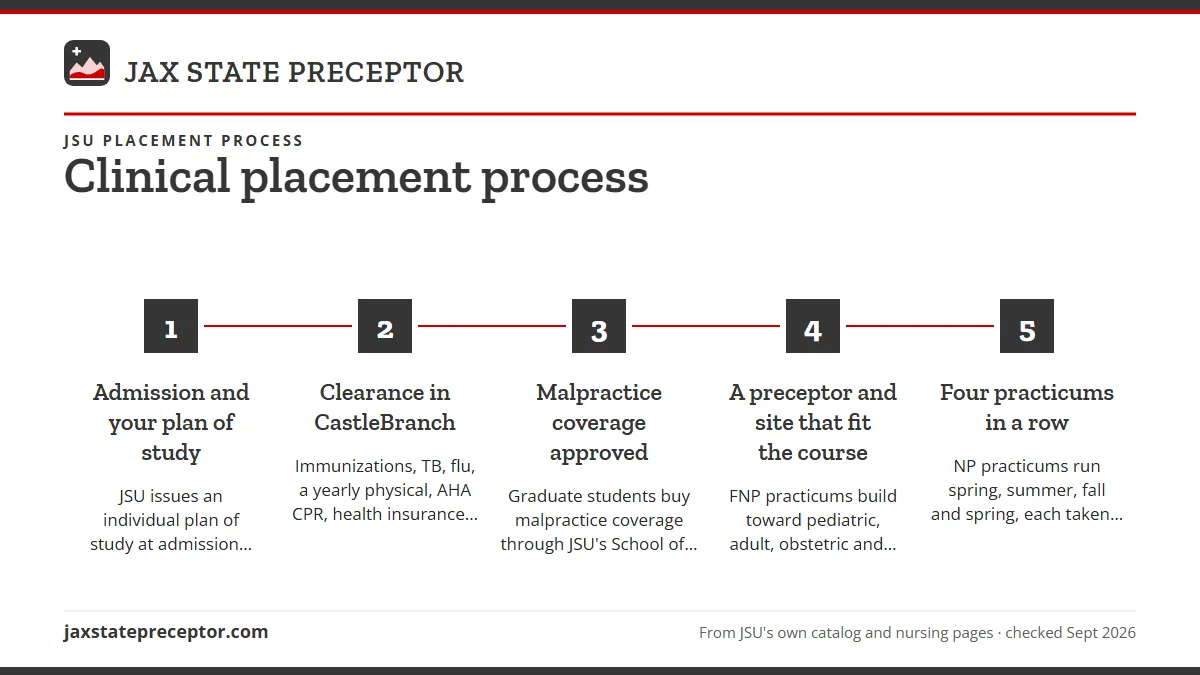
The path, step by step
- Admission and your plan of studyJSU issues an individual plan of study at admission. Graduate students also sign an out-of-state residence statement, and any later change in state of residence, employer or projected clinical experience has to be reported and approved.
- Clearance in CastleBranchImmunizations, TB, flu, a yearly physical, AHA CPR, health insurance, your RN license and five signed forms go into CastleBranch, and missing items can block registration. The CastleBranch guide lists each one.
- Malpractice coverage approvedGraduate students buy malpractice coverage through JSU's School of Nursing, and the proof must be approved in the tracker before any contact with a practicum or residency site. See malpractice and health insurance.
- A preceptor and site that fit the courseFNP practicums build toward pediatric, adult, obstetric and geriatric patients; AGACNP practicums center on late adolescents, adults and older adults in acute care. Faculty give the final approval and contract paperwork follows, as the approval guide explains.
- Four practicums in a rowNP practicums run spring, summer, fall and spring, each taken alongside its lecture course. JSU awards the MSN after Practicum IV, and the doctoral phase begins that summer.
- The DNP residency runIn
DNP 8796a preceptor and clinical site are set for the residency, and contract paperwork goes in. That same pair carries you throughDNP 8797,DNP 8798andDNP 8799, a July Dissemination Day on campus and an August graduation. The residency pairing page has the detail.
Where each program's first placement falls
| Program | First clinical course | Term on JSU's plans | What JSU says about the setting |
|---|---|---|---|
| BSN-DNP FNP | FNP 7869 Practicum I, 120 hours | Spring of Year 2 (spring only) | Hours earned with a licensed preceptor |
| BSN-DNP AGACNP | ANP 7869 Practicum I, 70 hours in the catalog, 110 on the plans of study | Spring of Year 2 (spring only) | Acute care; the 2024-25 handbook called these simulation hours |
| Post-Master's DNP | DNP 8797 Residency I, 210 hours, after DNP 8796 | Fall of Year 2 (fall start) or spring of Year 2 (spring start) | One preceptor and site across the residency courses |
| MSN Population Health and concentrations | NU 5980 Population Health I, 254 practicum hours | Summer only | Designed around each student's learning needs |
| MSN Nursing Education and the certificate | NU 5982, a 100-hour teaching practicum | Semester 5 (spring) on the MSN plan | Planned with the student at a convenient location |
| STEP RN-BSN | NU 456 Population-Based Health Care | Semester III (summer on the catalog grid) | Shaped to the RN's individual learning needs |
| Traditional BSN | NU 311, then the NU 428 preceptor practicum | Junior fall; senior summer for NU 428 | Course faculty and a clinical preceptor supervise NU 428 |
For how these terms line up with a fall or spring start, see the first clinical course guide.
Three rules that shape your timeline
Each NP practicum is offered once a year and is a corequisite of its lecture course. If either one is not passed, both are retaken together, and the next offering of that term is a year away. A preceptor who is not confirmed by the first week puts the whole pair at risk.
Grades set the pace as well. Clinical courses expect a B or better in the coursework before them, and only one course graded C or lower may be repeated. The grades and progression guide gives the full rule.
Where you live is the third factor. JSU considers residents of five states for its NP tracks, and a change in your state or planned clinical location must be approved. The admission states guide covers each state.
Get malpractice approval in the tracker first: JSU ties any contact with a practicum or residency site to it.
Where JSU's own sources disagree
A few published figures conflict, and each one touches placement planning. Read the 2026-27 catalog first, then confirm with your course faculty or program coordinator.
- BSN-DNP totals: the track web pages say 700 clinical hours, the catalog says 1330, and the catalog's own per-course hours add up to neither. Plan by course, not by total.
- AGACNP Practicum I: 70 hours in the catalog and NP timeline, 110 on both AGACNP plans of study.
- Course numbers: the 2024-25 handbook prints three-digit numbers such as FNP 669, while the catalog uses
FNP 7869. - Residency prefixes: the catalog prints DNP 8796 to 8799, and the fall plans of study print FNP or ANP in front of the same numbers.
- Spring starts: the DNP web pages and spring plans of study support them, while the catalog also says fall only.
Why JSU students choose us for placement
We are specialists in JSU's clinical process, and every search starts from your course, not a generic directory. We read your plan of study, note which practicum or residency comes next and how many hours it carries, and look for a preceptor near home whose practice sees the population that course covers.
Before any site hears from us, we confirm your CastleBranch items and malpractice approval are in order. Then we assemble what JSU's faculty need to clear the match: the preceptor's license, certification and practice details, and the site's details for a contract. For DNP students we look for a pair that can stay for the whole residency, and if a preceptor drops at any stage we stay on call and find a replacement.
Tell us your program and term with the form below, or read how it works.
Questions JSU students ask
Does JSU place nursing students with preceptors?
JSU's public documents do not answer that in one rule. They describe malpractice approval before any site contact, a 2026 invitation for clinical partners to host students, and a residency pairing described without naming who makes it. Your track clinical coordinator can explain how it works for your cohort. Either way, we find you a preceptor and site that fit JSU's rules.
How early should a JSU NP student start planning Practicum I?
JSU publishes no lead time for NP practicums. Practicum I sits in spring of Year 2 on both the fall and spring plans of study, and clearance plus malpractice approval come before any site contact, so the months leading into that spring are the working window. We start as soon as you know your practicum term.
Can I change the state or site of my JSU clinicals after admission?
A change in state of residence, employment or projected clinical experience goes to your course faculty, the program coordinator and the Administrative Coordinator, Graduate Programs, and it must be approved. The 2024-25 handbook makes no promise that progression continues unchanged, so raise any move early and have a new preceptor option ready.
Which JSU document wins when figures differ?
Start with the 2026-27 graduate catalog, which carries the current four-digit course numbers and practicum hours. The plans of study and timeline PDFs add term-by-term timing, and the 2024-25 handbook still sets clearance and conduct rules until JSU posts a newer edition. Your course faculty and program coordinator settle anything the documents leave open.
Do Post-Master's DNP students follow the same steps?
Largely. Post-Master's students clear CastleBranch and malpractice approval like everyone else, then meet the residency pairing in DNP 8796 and complete 210 hours in each of three residency courses. Applicants with fewer than 500 validated master's clinical hours first take NU 5841, the Advanced Experiential Clinical Course, which carries its own clinical hours.
Related pages
Last checked 2026-09-27
We check these pages against JSU's 2026-27 catalog, nursing handbooks, program pages and licensure disclosures. Your course faculty and your plan of study have the final word.
Whether JSU helps or you start alone, we find the preceptor.
Tell us your JSU program, your next practicum or residency and the town you train near. We find preceptors and sites that fit the course and gather what JSU's faculty need to clear them, early enough for the semester.
- Preceptors matched to the course: family practice across the lifespan, adult-gerontology acute care, DNP residencies
- License, certification and site details ready for JSU's clearance, with your CastleBranch and malpractice items in order
- Across Alabama and in Georgia, Florida, Mississippi and Tennessee
Start your placement plan
Your program, your town and your next clinical semester is all we need to begin.