JSU's MSN in Population Health and its two practicums
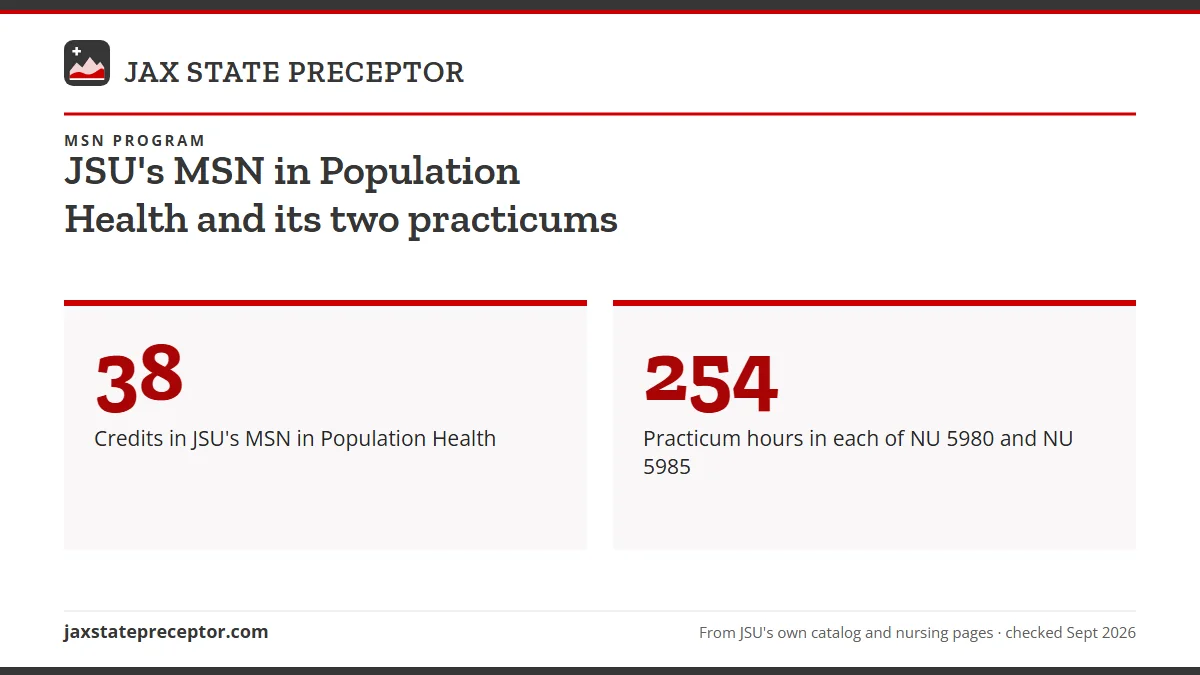
JSU's MSN in Population Health is a 38-credit online program built around two practicum courses, NU 5980 and NU 5985, at 254 hours each. On JSU's sample plan it takes four semesters, with the practicums in the third and fourth. Here is the plan, the rules that govern the practicums and how we find settings that suit them.
Get your placement plan
Tell us your JSU program and where you live. A placement advisor replies with the preceptor and site options that fit your JSU course.
What the Population Health MSN is
The 2026-27 catalog lists the program as Population Health (Master of Science in Nursing). JSU started its MSN in Fall 1999 under the name Community Health, and population health remains the only MSN major the School of Nursing offers. It is not a nurse practitioner program: JSU teaches NP practice only inside its BSN-DNP.
JSU's MSN overview calls the program fully online with a required practicum, while the program page adds that some on-campus requirements may be required. The on-campus requirements page looks at that gap. You can study full or part time.
The same major comes in two longer forms. The Nursing Education concentration and the Emergency Management concentration each run 53 credits and keep both population health practicums, adding either a teaching practicum or emergency management coursework. The 38-credit version on this page is the plain major, with no concentration attached.
The four-semester sample plan
JSU's web page shows a sample plan for a fall start. Your own plan of study can differ with your entry term and a part-time pace, but the course list stays the same.
| Semester | Courses (credits) |
|---|---|
| 1, Fall | NU 5101 MSN Online Orientation (0), NU 5204 Theories in Nursing (2), NU 5207 Advanced Health Assessment (3), NU 5218 Organizational and Systems Leadership in Population Health (3) |
| 2, Spring | NU 5213 Advanced Pathophysiology (3), NU 5227 Epidemiology (3), NU 5744 Statistical Methods in Health Care (3), NU 5242 Transcultural Nursing and Healthcare (3) |
| 3, Summer | NU 5722 Nursing Research (3), NU 5980 Population Health I (6, practicum) |
| 4, Fall | NU 5985 Population Health II (6, practicum), NU 5220 Advanced Pharmacology (3) |
Notice the plan's shape. The first two semesters carry no practicum hours at all, then the last two each pair a six-credit practicum course with one other class. That shape gives you two full semesters to settle a practicum setting before NU 5980 begins.
NU 5980 and NU 5985: summer, then fall
In the 2026-27 catalog, each practicum course carries 254 hours. NU 5980 Population Health I is offered in summer only, and NU 5985 Population Health II in fall only, so the two sit back to back across one summer and the fall that follows.
Prerequisites set the order. NU 5980 requires the orientation plus theory, advanced health assessment, leadership, pathophysiology, epidemiology and statistics (NU 5101, NU 5204, NU 5207, NU 5213, NU 5218, NU 5227 and NU 5744). NU 5985 then requires NU 5722 and NU 5980. Reading those against the catalog's term listings, the earliest NU 5980 can fall is the summer after you have completed one fall and one spring.
JSU's catalog describes the clinical experiences as shaped around each MSN student's learning needs, rather than a fixed rotation. The population health practicums page covers what the two courses ask of you and your setting.
Admission and staying on track
Admission asks for a 3.0 GPA, with conditional entry possible at 2.5, and a current, unencumbered RN license; JSU asks for no GRE or MAT scores. JSU's MSN pages ask anyone living outside Alabama to reach out to the School of Nursing first, before an application goes in.
Once enrolled, grades decide your pace. The practicum courses set a B-or-better standard for all earlier graduate work. JSU lets you repeat one course with a C or below, a single time, and the repeat has to earn an A or B; a student whose C grades pass 3 credits can no longer continue. The MSN has no comprehensive exam, must be finished within six years, and accepts up to 12 transfer hours under the graduate handbook. Full rules sit on the grades and progression page.
One handbook rule is easy to miss: if you move states, switch employers or change your planned clinical experience, report it to faculty and wait for approval before you progress.
Population health needs close to JSU
The counties around Jacksonville give a population health student plenty to work on. HRSA data list Calhoun County, JSU's home, with a primary care shortage designation for its low-income population and a geographic mental health designation. Talladega County's primary care designation scores 20 on HRSA's 0 to 25 scale, and Cleburne and Coosa counties have no hospital in the Alabama Hospital Association's directory.
Statewide, the Alabama Department of Public Health counts 58 of Alabama's 67 counties as rural. Access, distance and the reach of primary care are the questions a population health practicum can tackle, whether you live in Calhoun County or elsewhere in the state.
For the practicum, that points toward settings that serve whole groups: public health programs, community clinics, health system population and quality teams, and organizations working on rural access. Your course faculty decide what fits the course objectives; we find options that match what they ask for.
How we arrange your population health practicum
However your practicum ends up being arranged, we find you a setting and preceptor near home that meet JSU's rules and suit both NU 5980 and NU 5985. Because the courses run in consecutive terms, we look first for an organization that can host you through the summer and the fall, which keeps one relationship and one set of paperwork in place.
We gather the preceptor's credentials and the organization's details for any contract well before the summer. Before the organization hears from anyone, we also confirm that JSU has signed off on your malpractice coverage and that your CastleBranch file is complete, as the CastleBranch page describes. If a setting falls through, your placement advisor starts a replacement search right away.
Faculty at JSU sign off on every setting and preceptor. We handle the legwork so the file they review is whole and matches JSU's rules from the start. Tell us your start term and county in the form below.
Questions JSU students ask
Is JSU's MSN in Population Health a nurse practitioner program?
No. JSU offers no MSN nurse practitioner track. JSU trains nurse practitioners only within the BSN-DNP, in its FNP and AGACNP tracks. The Population Health MSN centers on population health, and its practicum hours are population health hours rather than NP clinical hours.
Can I start JSU's Population Health MSN in spring or summer?
Yes. JSU accepts MSN students in fall, spring and summer, with application deadlines of July 1, November 1 and April 1, and it may accept late applications if seats remain. Because the two practicums run only in summer and fall, a spring or summer start changes where they land, so rely on the individual plan of study you receive.
Can I do JSU's MSN practicums outside Alabama?
Possibly, depending on your state. Applicants living beyond Alabama are asked to check with the School of Nursing ahead of applying, and the graduate handbook has each student sign a statement about out-of-state residence on enrolling. Some states also regulate clinical placements by programs based elsewhere, as our state guides explain, so settle your state with JSU before you apply.
How long does JSU's MSN take part time?
JSU does not publish a part-time sample plan, only the four-semester full-time version. A part-time schedule spreads the other nine courses over more terms, but the practicums still follow their fixed summer and fall slots. Whatever the pace, JSU's six-year limit for the MSN applies, and your plan of study sets the exact sequence.
How many practicum hours are in JSU's Population Health MSN?
NU 5980 and NU 5985 each carry 254 practicum hours in the catalog. JSU does not print a combined figure, so plan course by course. Students in the Nursing Education concentration add the 100-hour teaching practicum in NU 5982, and the Emergency Management concentration adds coursework without extra practicum hours.
Does JSU's MSN require a comprehensive exam?
No. JSU's graduate handbook limits the comprehensive exam to the BSN-DNP nurse practitioner tracks, so MSN students finish through coursework and the two practicums. Grades still matter throughout: each clinical course expects prior graduate work at B or better, and C grades totaling over 3 credits make a student ineligible to continue.
Related pages
Last checked 2026-09-27
We check these pages against JSU's 2026-27 catalog, nursing handbooks, program pages and licensure disclosures. Your course faculty and your plan of study have the final word.
Whether JSU helps or you start alone, we find the preceptor.
Tell us your JSU program, your next practicum or residency and the town you train near. We find preceptors and sites that fit the course and gather what JSU's faculty need to clear them, early enough for the semester.
- Preceptors matched to the course: family practice across the lifespan, adult-gerontology acute care, DNP residencies
- License, certification and site details ready for JSU's clearance, with your CastleBranch and malpractice items in order
- Across Alabama and in Georgia, Florida, Mississippi and Tennessee
Start your placement plan
Your program, your town and your next clinical semester is all we need to begin.