Adult-Gerontology Acute Care NP at JSU: the ANP practicums and the DNP that follows
JSU's acute care nurse practitioner track shares the BSN-DNP's 69 credits and doctoral block with the family track, but its four ANP practicums lead you toward hospital medicine and older adults. Acute care sites tend to run their own intake rules, so early preparation pays off. Below is how the track is built and how we help cover each semester.
Get your placement plan
Tell us your JSU program and where you live. A placement advisor replies with the preceptor and site options that fit your JSU course.
How JSU frames the acute care track
In the 2026-27 catalog the program is Adult-Gerontology Acute Care Nurse Practitioner (Doctor of Nursing Practice). JSU's web pages shorten that to AGACNP, the specialty courses carry an ANP prefix, and the School of Nursing's page for clinical partners calls these learners ANP students. All three labels point to the same 69-credit online plan, with some on-campus events possible along the way.
The ANP courses are written around late adolescent, adult and geriatric clients. That age band, rather than the whole lifespan, is what a preceptor's patient load should reflect, and it steers the search toward hospitalist groups, inpatient units and other acute settings that manage adults and older adults.
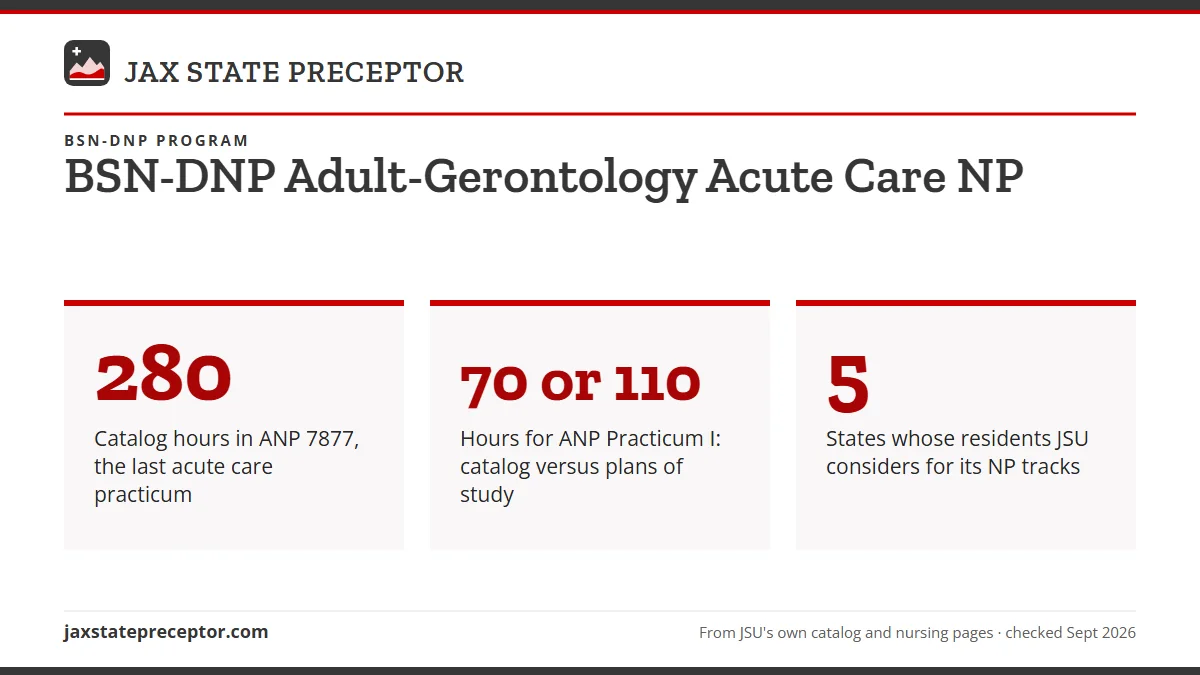
Entry standards mirror the family track: a GPA of 3.0 overall and 2.5 in the sciences, plus an unencumbered RN license, with fall and spring deadlines on JSU's web pages even though the catalog text mentions fall only. State of residence matters most. JSU weighs applications to its NP tracks only from Alabama, Georgia, Florida, Mississippi and Tennessee, which the admission states page explores.
Where the ANP sequence begins
Acute care students take the same core semesters as the family track, course for course and term for term, until the specialty year. NU 7007, NU 7013 and NU 7020 (advanced assessment, pathophysiology and pharmacology) must be done before ANP 7068, ANP 7869 and ANP 7071 can start, and the 2024-25 handbook asks that those three foundations fall within two years of beginning specialty coursework.
ANP 7869, the first acute care practicum, lands in Spring of Year 2 whichever entry plan you follow, because the catalog offers it in spring only. After that the four practicums run back to back: spring, summer, fall, then spring again. A gap in any one of them stalls the sequence, since each pair of courses returns only once a year.
ANP practicums, term by term
Each practicum is a corequisite of the lecture beside it; fail either one and both are repeated together. The figures below come from JSU's 2026-27 catalog, with the one disputed number flagged. Course focus and setting notes are on the AGACNP practicum guide.
| Course | Taken with | Semester | Hours in the catalog |
|---|---|---|---|
ANP 7869 Practicum I (2 credits) | ANP 7068 and ANP 7071 | Spring | 70 (both plans of study print 110) |
ANP 7873 Practicum II (3 credits) | ANP 7072 | Summer | 210 |
ANP 7875 Practicum III (3 credits) | ANP 7074 | Fall | 250 |
ANP 7877 Practicum IV (3 credits) | ANP 7076 | Spring | 280 |
The later practicums grew between editions. JSU's 2024-25 graduate handbook listed Practicums II, III and IV at 210 hours each; the current catalog and plans of study raise III to 250 and IV to 280. Once ANP 7877 is complete, JSU's plans award the MSN and the student moves into the DNP semesters.
Practicum I: the 70 or 110 hour question
ANP 7869 carries the most tangled figures in the track. The 2026-27 catalog gives it 70 clinical practicum hours, and JSU's NP timeline agrees. Both AGACNP plans of study, fall and spring, print 110. The 2024-25 handbook called the course's 70 hours simulation practicum hours, and JSU's South Complex Annex houses a high-fidelity simulation center.
What that leaves open is how many hours you owe and how many of them happen with a preceptor rather than in simulation. JSU's web pages describe the track's clinical hours as a blend of simulation and direct patient care without splitting them by course. The page on what counts as clinical hours sets out what JSU publishes on that split.
Program totals conflict as well, with 700 hours on JSU's web pages and 1330 in the catalog, so this site prints hours course by course. The BSN-DNP hours page explains the gap.
Ask your ANP course faculty during the fall before Practicum I whether you owe 70 or 110 hours and how many are simulation, then plan the preceptor's schedule around that answer.
Hospitals keep their own entry rules
Acute care practicums usually mean a hospital, and hospitals keep their own intake steps for NP students from outside programs. Many Alabama systems post none at all. Where rules are posted, they tend to want an agreement with the school first and a preceptor already named, sometimes months ahead. A few examples from the region show the range.
- Huntsville Hospital's NP student registration needs an affiliation agreement already in force and an answer on whether you have a preceptor lined up; JSU is absent from its school list
- In Rome, Georgia, Atrium Health Floyd names JSU on its current NP agreement list, wants applications at least three months ahead, and a Floyd teammate or affiliated practice member must first say yes to precepting before the application goes forward
- Riverview Regional in Gadsden wants a student profile form in hand two weeks or more ahead of the first clinical day, on a page written for school-led groups
- RMC in Anniston names JSU for its RN and LPN programs but posts no NP placement page
JSU's own clearance runs alongside these hospital steps, covered on the preceptor and site approval page. Starting early is what keeps a hospital's lead time from colliding with a JSU semester.
After the MSN: one acute care site for the residencies
The doctoral block is identical for both NP tracks. DNP 8796 DNP Project Planning and Development opens the summer after Practicum IV, and the DNP timeline puts most students' preceptor and site pairing in late May, with a smaller group on an August track. The DNP 8796 course page covers that summer in detail.
Three residencies follow at 210 hours each, DNP 8797 in fall, DNP 8798 in spring and DNP 8799 in summer, all anchored to one preceptor and one site across 16 months. For acute care students that site can be a hospital unit or service line willing to see a quality improvement project through from its proposal to its results. The fall-entry AGACNP plan labels these courses ANP 8796 to 8799; the catalog's DNP numbers are the ones this site uses. More on each residency is in the residency course guide.
How we cover each ANP semester
No matter how JSU handles your placement, we find acute care preceptors and sites that fit its rules and the practicum in front of you. Our work centers on the details acute care adds: hospital lead times, agreement status, unit schedules and a preceptor whose patients match the ANP age band.
For each semester we assemble the preceptor's license, board certification and a description of the practice, plus the facility details a contract needs. Before any site is approached, we check that CastleBranch shows you compliant and that JSU has approved your malpractice coverage, following the CastleBranch compliance page. For the doctoral year we look for a unit that can stay with your project for all 16 months, and if a preceptor falls through mid-term, we start on a replacement right away.
Every preceptor and site still needs JSU faculty approval. What we add is a clean, complete submission that meets JSU's rules on the first try. Tell us your entry term and nearest city in the form below to start.
Questions JSU students ask
What is the difference between JSU's AGACNP and FNP tracks?
Both are 69-credit BSN-DNP tracks with the same core courses and the same three DNP residencies. The acute care track's ANP courses focus on late adolescent, adult and geriatric patients in acute settings, and its hours differ: ANP 7869 lists 70 hours against 120 for FNP 7869, and ANP 7877 lists 280 against 250 for FNP 7877.
Which certification exams can JSU AGACNP graduates take?
JSU's AGACNP page says graduates are eligible for the ANCC adult-gerontology acute care nurse practitioner exam and the AACN ACNPC-AG certification. Practicing in Alabama afterward also requires approval from the Alabama Board of Nursing for collaborative practice with a physician, which comes after national certification.
Does JSU's AGACNP track count simulation toward clinical hours?
JSU's track page says its NP clinical hours combine simulation and direct patient care, and JSU's older 2024-25 graduate handbook labeled the first ANP practicum's 70 hours as simulation. The current catalog simply lists 70 practicum hours. Because the sources differ, confirm the split for each practicum with your course faculty.
Do AGACNP students at JSU earn an MSN?
Yes, partway through. JSU's AGACNP plans of study award the MSN after ANP 7877, the fourth acute care practicum, and students then continue four more semesters to the DNP. JSU does not offer a standalone MSN acute care track, so the BSN-DNP is the only route into this specialty there.
What happens if I fail an ANP lecture or practicum?
The pair is retaken together, and each pair runs just once a year, so a retake has to wait until that semester comes back around. JSU allows only one graduate course graded C or lower to be repeated, once, for an A or B. Once C grades exceed 3 credits, the student cannot continue.
Related pages
Last checked 2026-09-27
We check these pages against JSU's 2026-27 catalog, nursing handbooks, program pages and licensure disclosures. Your course faculty and your plan of study have the final word.
Whether JSU helps or you start alone, we find the preceptor.
Tell us your JSU program, your next practicum or residency and the town you train near. We find preceptors and sites that fit the course and gather what JSU's faculty need to clear them, early enough for the semester.
- Preceptors matched to the course: family practice across the lifespan, adult-gerontology acute care, DNP residencies
- License, certification and site details ready for JSU's clearance, with your CastleBranch and malpractice items in order
- Across Alabama and in Georgia, Florida, Mississippi and Tennessee
Start your placement plan
Your program, your town and your next clinical semester is all we need to begin.