What a JSU NP or DNP preceptor needs
JSU's public pages ask for little beyond a licensed preceptor, so the working standard comes from three places: Alabama's definition of an advanced practice preceptor, the population each course covers, and how long the course runs. This page sets out each one, and what we check before a preceptor's name ever reaches your faculty.
Get your placement plan
Tell us your JSU program and where you live. A placement advisor replies with the preceptor and site options that fit your JSU course.
What JSU itself says
JSU's FNP and ANP clinical timeline says students earn their hours while working with a licensed preceptor. Beyond that line, the 2026-27 catalog, the plans of study and the 2024-25 graduate handbook publish no list of NP or DNP preceptor qualifications: nothing on years in practice, required credentials or a cap on students per preceptor.
That places the judgment with the course. Faculty decide whether a preceptor suits the practicum or residency in front of them, so the questions on this page are the ones worth answering before a name goes in. Your track clinical coordinator can confirm anything specific to your cohort.
The handbook's clinical rules focus on the student instead: clearance items, malpractice coverage, ID badges and conduct in the clinical setting. The preceptor side is left to each course and its faculty.
Alabama's definition of an advanced practice preceptor
The Alabama Board of Nursing defines the role for advanced practice programs in Ala. Admin. Code r. 610-X-3-.01(9): the rule lets an advanced practice nurse, a physician or another clinician with the right license and a population focus act as clinical supervisor, coordinator or preceptor, guiding the student as role model, resource and educator. JSU does not cite the rule in its handbook, but it is the state standard for an Alabama APRN program.
Two ideas in that rule do the heavy lifting. The licensing piece asks for a license that works in whichever state hosts the clinical. The population piece asks that the preceptor treat the same patients the student is being prepared to care for, and at JSU that divides cleanly by track.
In Alabama, a certified registered nurse practitioner practices in collaboration with a physician under rules the nursing and medical boards share; the Alabama practice guide explains how that shapes precepting.
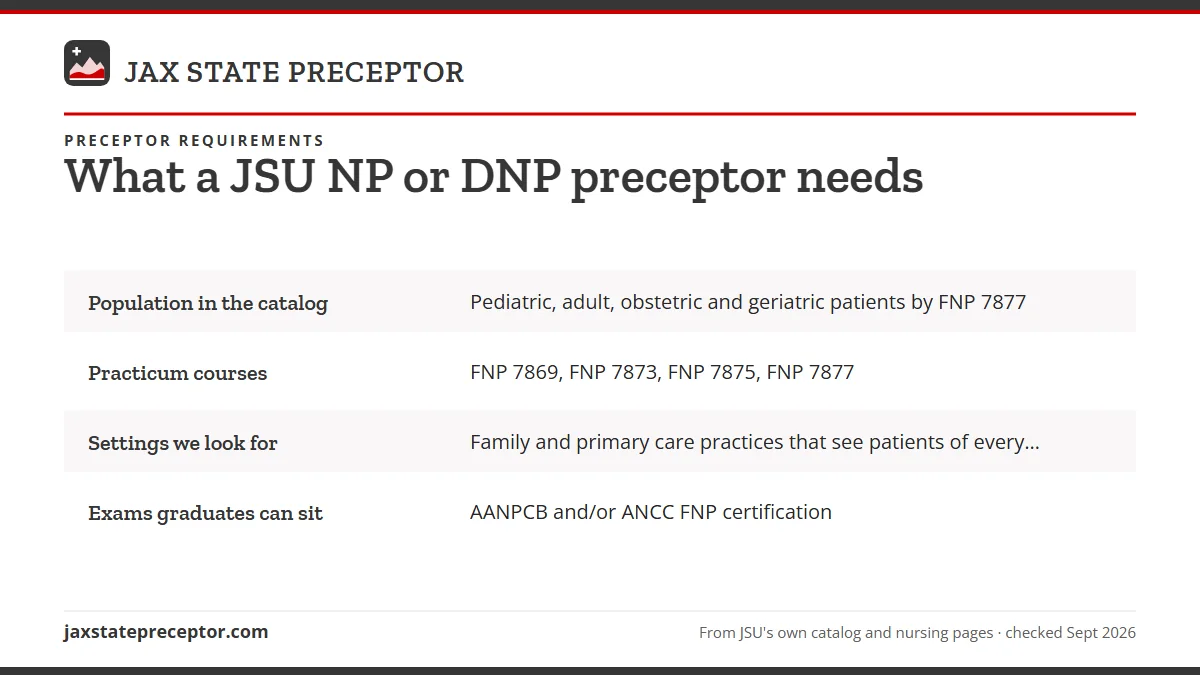
Track fit: FNP compared with AGACNP
| FNP track | AGACNP track (ANP prefix) | |
|---|---|---|
| Population in the catalog | Pediatric, adult, obstetric and geriatric patients by FNP 7877 | Late adolescent, adult and geriatric clients |
| Practicum courses | FNP 7869, FNP 7873, FNP 7875, FNP 7877 | ANP 7869, ANP 7873, ANP 7875, ANP 7877 |
| Settings we look for | Family and primary care practices that see patients of every age | Hospital-based and other acute care settings for adults and older adults |
| Exams graduates can sit | AANPCB and/or ANCC FNP certification | ANCC and/or AACN ACNPC-AG certification |
A practice that sees mostly one age group may suit one FNP practicum and not the next, so judge each practice against the specific course rather than the whole track.
Hours for each course are on the FNP practicums and AGACNP practicums pages.
DNP residency preceptors
The residency asks for something different. DNP 8797, DNP 8798 and DNP 8799 carry 210 hours each, and JSU's DNP timeline expects one preceptor and one clinical site across the whole run instead of a fresh match each semester. The work is a quality-improvement project inside the preceptor's organization, so reach within that organization counts as much as clinical skill.
Per the timeline, a residency preceptor meets the student four times each semester, first to plan and then to carry out the project, suggests content for the Executive Summary, and hosts the on-site sharing of results in July. For NU 5841, the pre-DNP clinical course, the catalog also allows hours with organizational leaders. The pairing itself is covered on the residency pairing page.
Licensing where the clinical happens
Your preceptor must hold a license recognized by whichever state hosts your hours. All five states JSU takes NP applicants from belong to the Nurse Licensure Compact for RNs, yet advanced practice authority is granted state by state. Alabama, for one, still makes APRNs apply for advanced practice approval even when their compact RN license was issued by another member state.
Georgia's board is direct about programs based elsewhere: whoever teaches an APRN student clinically in Georgia needs Georgia APRN authorization, and preceptors there need a Georgia or multistate license. Your own RN license matters too, and JSU words that rule two ways; the RN license page sets out the conflict. We verify license status for every preceptor before a name goes to JSU.
What JSU once published for undergraduate preceptors
The only detailed preceptor criteria JSU has posted were for the traditional BSN's NU 428 practicum, on pages retired around 2021. They asked for a BSN or higher, at least one year of nursing experience, one student per clinical shift as the Board specifies, a time log signed daily, and evaluations at midterm and at the end. They also ruled out precepting with relatives or friends, or on the student's own unit of employment.
Those rules do not govern NP courses. They do show what JSU has asked of preceptors before: experience, distance from personal and work ties, and signed records of time. Until your faculty say otherwise, they make sensible defaults to plan around.
How we qualify a preceptor for JSU
We match every preceptor to your course before anything goes to JSU. That means a license checked for the state of your clinical, certification and practice focus lined up with your track, a setting that sees the course's population, and availability for the full hours of the JSU semester. For DNP students, we confirm the preceptor and organization can commit for the entire residency.
You get a preceptor whose details are already organized the way faculty need them, which is the fastest path to approval at JSU. Should a preceptor leave partway through a term, we remain on call and line up a new match for that same course. Send your details through the form below, or read about our process.
Questions JSU students ask
Can a physician precept a JSU nurse practitioner student?
Alabama's advanced practice rule lists physicians among the clinicians who may precept, next to APRNs, and JSU publishes no rule against it. What matters is fit: the physician's practice should see the population your practicum covers, and your course faculty clear the choice.
How many years of experience does a JSU NP preceptor need?
JSU does not publish a minimum for NP or DNP preceptors. Its retired undergraduate practicum asked for at least one year of nursing experience, which gives a sense of JSU's past expectations. Ask your course faculty whether they expect a minimum for your practicum before a preceptor's name is submitted.
Does a JSU preceptor have to practice in Alabama?
JSU publishes no rule tying preceptors to Alabama. Its NP tracks draw students from Alabama and four neighboring states, and the preceptor must be licensed for the state that hosts your hours. Each state's board treats out-of-state programs differently; the state guides, such as Georgia, cover the details.
What does JSU offer the people who precept its students?
JSU's public pages list no continuing education hours, adjunct title or similar benefit for preceptors. Separately, Alabama runs a Preceptor Tax Incentive Program, an income tax credit for eligible community-based preceptors whose rotations fall in medically underserved rural areas of the state and support Alabama-based programs. Preceptors can learn more on our page for preceptors.
Can one preceptor cover more than one JSU practicum?
JSU does not say either way. Continuity can help, but each practicum has its own population focus: FNP 7877, for example, reaches pediatric, obstetric, adult and geriatric patients, so a single practice may not suit every course. Faculty decide whether a returning preceptor fits the next course.
Related pages
Last checked 2026-09-27
We check these pages against JSU's 2026-27 catalog, nursing handbooks, program pages and licensure disclosures. Your course faculty and your plan of study have the final word.
Whether JSU helps or you start alone, we find the preceptor.
Tell us your JSU program, your next practicum or residency and the town you train near. We find preceptors and sites that fit the course and gather what JSU's faculty need to clear them, early enough for the semester.
- Preceptors matched to the course: family practice across the lifespan, adult-gerontology acute care, DNP residencies
- License, certification and site details ready for JSU's clearance, with your CastleBranch and malpractice items in order
- Across Alabama and in Georgia, Florida, Mississippi and Tennessee
Start your placement plan
Your program, your town and your next clinical semester is all we need to begin.