Grades and progression in JSU nursing
JSU's graduate nursing programs run on a B-or-better rule: a C does not count, only one course can be retaken, and a practicum that is not passed takes its paired lecture course with it. This guide shows how those rules work together, where the BSN and STEP rules differ, and why a preceptor problem can turn into a progression problem.
Get your placement plan
Tell us your JSU program and where you live. A placement advisor replies with the preceptor and site options that fit your JSU course.
The grading scale
JSU's School of Nursing grades on a fixed scale: A is 90 to 100, B is 80 to 89, C is 70 to 79 and F is 0 to 69. JSU's graduate programs issue no D grades, and a score below 70 percent in any nursing course is a failure.
Rounding is narrow. Unit exams are not rounded at all, and the final course grade is rounded to the ones place only, so a 69.495 stays a 69. Other graduate grade types you may see include P for pass on residency and selected courses, I for incomplete and NC for no credit.
The graduate handbook on JSU's site is the 2024-25 edition, which still uses the older three-digit course numbers. The grading and progression rules below come from that handbook and the 2026-27 catalog; where they overlap, the catalog is the current word.
B or better to move forward
Nearly every graduate clinical course in the catalog carries the same gate: to enter it, all earlier coursework counting toward your graduate nursing program must be finished with a B or better. That makes a single low grade a scheduling problem, not just a transcript entry.
Your overall GPA must also stay at 3.0 or above. Below that, you go on probation through The Graduate School and risk being dropped from the program.
The university sets a looser limit for graduate students in general, no more than six semester hours of grades below B. JSU's catalog notes that some programs set stricter rules, and nursing is one of them, as the next section shows.
C grades and the single retake
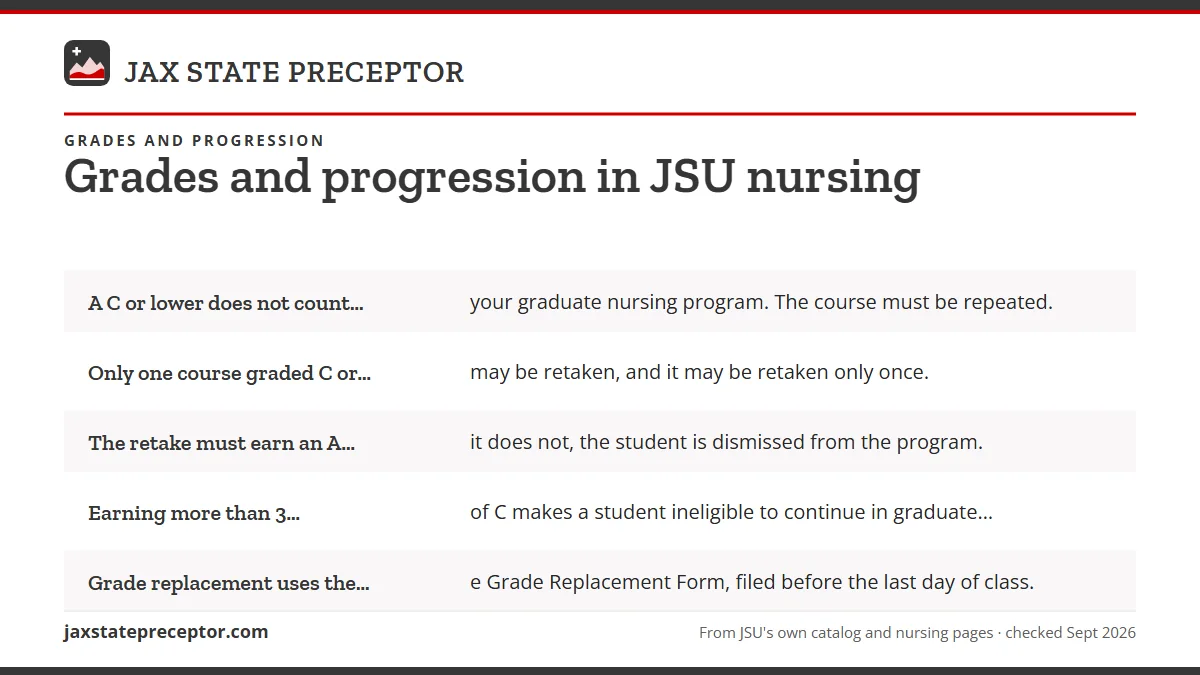
- A C or lower does not count toward your graduate nursing program. The course must be repeated.
- Only one course graded C or lower may be retaken, and it may be retaken only once.
- The retake must earn an A or B. If it does not, the student is dismissed from the program.
- Earning more than 3 semester hours of C makes a student ineligible to continue in graduate nursing.
- Grade replacement uses the Graduate Grade Replacement Form, filed before the last day of class.
JSU's catalog adds that a retake means progression in the program will be affected. Because most clinical courses require every earlier course at B or better, a C in a lecture course can hold back the next practicum as well.
Paired courses: the rule that catches practicum students
JSU pairs each NP practicum with its lecture courses as corequisites. Practicum I in the FNP track, FNP 7869, runs alongside FNP 7068 and FNP 7071 in the same spring; the acute care track pairs ANP 7869 with ANP 7068 and ANP 7071 the same way. The catalog is blunt about what follows: if one or both corequisite courses is not passed, the student must retake all of them together.
That means a strong lecture grade does not protect you if the practicum is not passed, and the reverse holds too. Each NP course runs in only one term a year (Practicum I in spring, II in summer, III in fall, IV in spring), so a retake waits for that term to come around again, pushing the rest of the plan of study back with it.
Since only one course may be retaken, the pair counts against that single allowance. The FNP practicum guide lists every pairing and its term.
If a JSU practicum is not passed, its paired lecture courses are retaken with it, whatever grade you earned in them.
Residency grades, incompletes and the comprehensive exam
The catalog marks DNP Residency II and III as Pass/Fail and does not state the grade type for Residency I. An F on a pass/fail course counts as a regular F, and a student may be required to retake DNP 8796, the project planning course.
An incomplete is not a quiet extension. JSU's nursing handbook says an unresolved incomplete blocks registration for the next semester, and the catalog's grade rules allow an I only when the student is already passing. The steps and deadlines are in the academic calendar guide.
BSN-DNP students also sit a comprehensive exam, offered in spring (April or May) and required for graduation. After a first or second failure, the student gets remediation and a retake; after a third, the course grade stays Incomplete until the exam is passed. The Post-Master's DNP and the MSN have no comprehensive exam. The three advanced core courses in pathophysiology, health assessment and pharmacology must be completed within two years of starting NP specialty coursework.
Time limits, dismissal and appeals
The MSN and graduate certificates must be finished within six calendar years, and the DNP within seven. Exceptions go to the Graduate Dean.
Beyond the nursing rules, the university dismisses graduate students who fall more than six hours down on grade points, meaning they would need seven hours of A grades to recover. Academic integrity offenses also add up: JSU treats them as cumulative across every School of Nursing course.
A dismissed student may appeal for readmission once per graduate program, after at least one semester has passed, using the Graduate Ineligibility Appeals Form sent to the Associate Vice Provost and Dean of Graduate Studies. The Appeals Committee's decision is final and cannot be appealed again.
BSN and STEP RN-BSN rules
The undergraduate programs use a C-or-above standard in every nursing course. In the traditional BSN, a failed course is repeated the next semester if it can be scheduled. Dismissal follows failing the same course twice, failing two courses, failing one course plus unsatisfactory clinical performance, or unsatisfactory clinical performance in two courses. Failing clinically and then dropping before the penalty date still counts as a failure, and students who drop or fail enroll in JSU's RISE program. BSN students also need a 90 percent medication calculation score before giving medications in any clinical, including the NU 428 preceptorship.
STEP RN-BSN students are dismissed after failing the same course twice or failing two courses, and must keep an active, unencumbered U.S. RN license throughout.
Protecting your progression with the right preceptor
Because a practicum and its lecture courses stand or fall together, the preceptor behind your hours is part of your progression plan. Whether JSU helps line up your preceptor or not, we find one who can host the full course inside the term, and we have your paperwork ready before the semester opens.
When a preceptor leaves partway through, our placement desk begins sourcing a successor immediately so the practicum, and the lecture courses tied to it, stay on track. Every substitute still goes to JSU's faculty for approval, with the credentials and site details already assembled. Read about backup preceptors and the steps when a preceptor drops out, or reach us through the form on this page.
Questions JSU students ask
Can I retake a C in JSU's graduate nursing program?
Yes, once. JSU allows one course graded C or lower to be retaken a single time, and the retake must earn an A or B. Failing the retake leads to dismissal, and earning more than 3 semester hours of C at any point makes you ineligible to continue in graduate nursing.
What happens if I fail an NP practicum at JSU?
You retake the practicum and its paired lecture courses together, because JSU treats them as corequisites. Each NP course runs in only one term a year, so the retake waits for that term to return. Talk with the program coordinator or lead faculty before withdrawing from any course.
Does JSU round final nursing grades?
Only the final course grade, and only to the ones place. Unit exams are not rounded. A final score of 69.495 therefore stays at 69, which is an F on JSU's nursing scale, since anything below 70 percent in a nursing course is a failure.
Can I appeal a dismissal from JSU's graduate nursing program?
You can apply for readmission once per graduate program, after at least one semester has passed since dismissal, through the Graduate Ineligibility Appeals Form. It goes to the Associate Vice Provost and Dean of Graduate Studies, and the Appeals Committee's decision is final.
Is the 2024-25 graduate handbook still current?
It is the newest graduate handbook posted on JSU's Program Information page, but it predates the 2026-27 catalog's course renumbering and some hour changes. Use the catalog first for course rules, and ask the School of Nursing whether a newer handbook has been issued.
Related pages
Last checked 2026-09-27
We check these pages against JSU's 2026-27 catalog, nursing handbooks, program pages and licensure disclosures. Your course faculty and your plan of study have the final word.
Whether JSU helps or you start alone, we find the preceptor.
Tell us your JSU program, your next practicum or residency and the town you train near. We find preceptors and sites that fit the course and gather what JSU's faculty need to clear them, early enough for the semester.
- Preceptors matched to the course: family practice across the lifespan, adult-gerontology acute care, DNP residencies
- License, certification and site details ready for JSU's clearance, with your CastleBranch and malpractice items in order
- Across Alabama and in Georgia, Florida, Mississippi and Tennessee
Start your placement plan
Your program, your town and your next clinical semester is all we need to begin.