What counts toward your JSU clinical hours
JSU builds its nurse practitioner clinical hours from two ingredients, simulated practice and hands-on patient care under a licensed preceptor, and publishes little beyond that. The detailed rules for each course sit with its faculty, so this guide gathers what JSU and the Alabama Board of Nursing do say and the questions to settle before you log a single hour.
Get your placement plan
Tell us your JSU program and where you live. A placement advisor replies with the preceptor and site options that fit your JSU course.
JSU's own words on counting hours
The clearest statement is on the FNP and AGACNP track pages, which describe the program's clinical hours as "composed of simulation and direct patient care." Simulation is therefore part of how JSU builds NP hours, not an extra on the side.
JSU's NP timeline adds that students earn their clinical hours across the last four semesters of the NP phase "while working with a licensed preceptor." The 2026-27 catalog gives each practicum its hour figure without splitting simulation from patient care. The one course JSU has labeled differently is the first acute care practicum: the 2024-25 handbook called its 70 hours simulation hours, while the current catalog calls them clinical practicum hours.
That is the full public picture. How many simulation hours a specific course accepts, which patient encounters qualify, and how hours are verified all live in the course itself, which you can open in Canvas once the semester begins.
Simulation: where it happens and Alabama's limit
JSU's simulation space is on the South Complex site in Jacksonville. Its high fidelity simulation center, along with lower fidelity practice labs, occupies the South Complex Annex, the building that was once Brookstone Medical Center. JSU's online graduate programs list on-site simulated learning among the on-campus events that may be required; the on-campus guide covers those visits.
The Alabama Board of Nursing sets a general ceiling in its education rules, Ala. Admin. Code r. 610-X-3-.02(12)(d)6: simulation may make up no more than 50 percent of clinical time for any course or patient population unless the Board authorizes more. JSU does not cite that rule on the pages we reviewed, and how it applies to a particular NP course is a question for JSU's faculty.
That chapter also obliges each program to record clinical hours to the standard certification bodies expect, and to hand the Board its clinical rotation plan if asked.
Direct patient care with a preceptor
Most of your NP hours will be spent with patients alongside a preceptor, and the population matters. JSU's catalog describes the final FNP practicum, FNP 7877, as covering pediatric, adult, obstetric and geriatric populations. The acute care courses cover late adolescent, adult and geriatric clients. Hours with patients outside the population a course names may not serve that course.
Alabama's rules define a preceptor for advanced practice programs as an advanced practice registered nurse, a physician or another appropriately licensed, population-focused clinician. JSU publishes no further NP preceptor standard; the preceptor requirements guide covers what is known.
JSU's handbook also asks you to tell course faculty before any absence, and it applies that rule to scheduled practicum time with a preceptor and to clinical simulations. A missed day is something to report, not just something to make up.
Residency, MSN and teaching practicum hours
Outside the NP practicums, JSU's wording shifts from patient care toward projects and settings. The DNP residency hours, 210 per course, belong to a quality improvement project that runs from proposal through ethics approval, a spring rollout and a July results session. For NU 5841, the pre-DNP clinical course, the catalog lets some practicum time be spent with organizational leaders rather than bedside clinicians.
The MSN population health practicums, NU 5980 and NU 5985, carry 254 hours each, and the catalog says their clinical experiences are designed around each MSN student's learning needs. The NU 5982 teaching practicum is planned with students in a location convenient for them, and the STEP RN-BSN's NU 456 is shaped around each RN's learning needs.
In each case the course faculty decide which activities count. Hour figures for every program are gathered in the clinical hours guide.
Gray areas to settle before you start
- Hours at your own workplace: JSU publishes no rule for graduate students. Its retired BSN practicum pages barred precepting on a unit of employment or with relatives or friends. Ask first; the workplace clinicals guide lists the questions.
- Time without your preceptor present: the retired BSN rule said no time accrues before the preceptor arrives or after the preceptor leaves. Ask whether your graduate course applies the same logic.
- Orientation days at a new site, charting time and travel between sites: none of these is addressed on JSU's public pages.
- A mid-term site change: JSU requires a change in projected clinical experience to be reported and approved, so hours at a new site may not count until that approval is in place.
- Logging: no hour-tracking tool appears anywhere on JSU's public graduate pages. CastleBranch is for compliance records, and each Canvas course explains how its hours are captured.
How to confirm what counts, course by course
No JSU page sets out a single checklist for counting hours, so these steps pull the public pieces into a routine you can repeat every term.
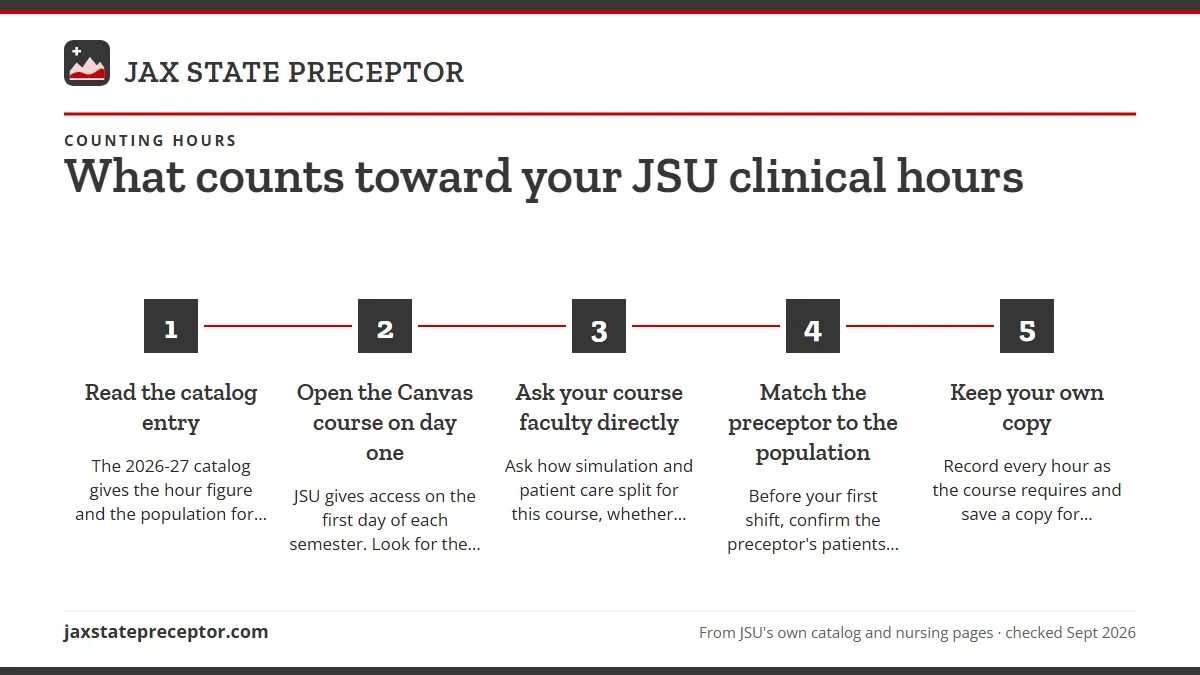
- Read the catalog entryThe 2026-27 catalog gives the hour figure and the population for each clinical course.
- Open the Canvas course on day oneJSU gives access on the first day of each semester. Look for the practicum guidelines and the hour-recording instructions.
- Ask your course faculty directlyAsk how simulation and patient care split for this course, whether workplace hours are accepted, and how hours are verified.
- Match the preceptor to the populationBefore your first shift, confirm the preceptor's patients fit the population the course names.
- Keep your own copyRecord every hour as the course requires and save a copy for yourself, course by course.
Matched so your hours count the first time
With or without JSU's help on your placement, we look for preceptors whose patients match the population your course names, so the hours you log fit that course. For the family practicums that means a practice seeing children, adults, pregnant patients and older adults; for acute care, settings with late adolescent, adult and older adult patients.
Well before the term, we verify the preceptor's license and national certification, note the patient mix they see, and gather the site facts a contract calls for. Your CastleBranch record and malpractice approval are checked off before we approach anyone. JSU's faculty decide whether each preceptor and site is approved, and they receive everything needed to decide quickly. Our process shows each step; to start, describe your course in the form at the bottom of the page.
Questions JSU students ask
Do simulation hours count for JSU FNP students?
JSU's FNP page describes the program's clinical hours as a combination of simulation and direct patient care, so simulation plays a part. JSU does not publish a per-course simulation limit. Alabama's education rules cap simulation at half of clinical time unless the Board authorizes more, so confirm the split for each course with your faculty.
Can I earn JSU clinical hours at my job?
JSU's public pages do not answer this for graduate students. The retired BSN practicum rules barred precepting on a unit of employment, which suggests caution. Ask your course faculty before you plan any hours where you work, and get the answer in writing.
Which app does JSU use to log clinical hours?
None of JSU's public sources, from the nursing pages to the catalog and graduate handbook, names a tool for tracking graduate clinical hours. CastleBranch appears only as the tracker for immunizations, licenses and other compliance records. Expect hour-recording instructions inside your Canvas course when the semester starts.
Do hours count if my preceptor is a physician?
Alabama's nursing education rules include physicians in the definition of a preceptor for advanced practice programs, alongside APRNs and other appropriately licensed, population-focused clinicians. Whether a given JSU course accepts one is for JSU's faculty to approve, so check before your first shift.
Do DNP residency hours have to involve patients?
JSU frames the residency around a quality improvement project rather than patient visits, with stages for design, ethics approval, rollout at the site and a closing report. The activities that count toward each residency's 210 hours are set in the course, so ask your course faculty early.
Related pages
Last checked 2026-09-27
We check these pages against JSU's 2026-27 catalog, nursing handbooks, program pages and licensure disclosures. Your course faculty and your plan of study have the final word.
Whether JSU helps or you start alone, we find the preceptor.
Tell us your JSU program, your next practicum or residency and the town you train near. We find preceptors and sites that fit the course and gather what JSU's faculty need to clear them, early enough for the semester.
- Preceptors matched to the course: family practice across the lifespan, adult-gerontology acute care, DNP residencies
- License, certification and site details ready for JSU's clearance, with your CastleBranch and malpractice items in order
- Across Alabama and in Georgia, Florida, Mississippi and Tennessee
Start your placement plan
Your program, your town and your next clinical semester is all we need to begin.