BSN-DNP clinical hours at JSU: three figures, one plan
JSU publishes three different pictures of BSN-DNP clinical hours: 700 on the FNP and AGACNP web pages, 1330 in the 2026-27 catalog's graduation rule, and per-course figures that add up to more than either. Treat the course hours in the current catalog as the working number for each term, and let your course faculty and program coordinator settle the program total.
Get your placement plan
Tell us your JSU program and where you live. A placement advisor replies with the preceptor and site options that fit your JSU course.
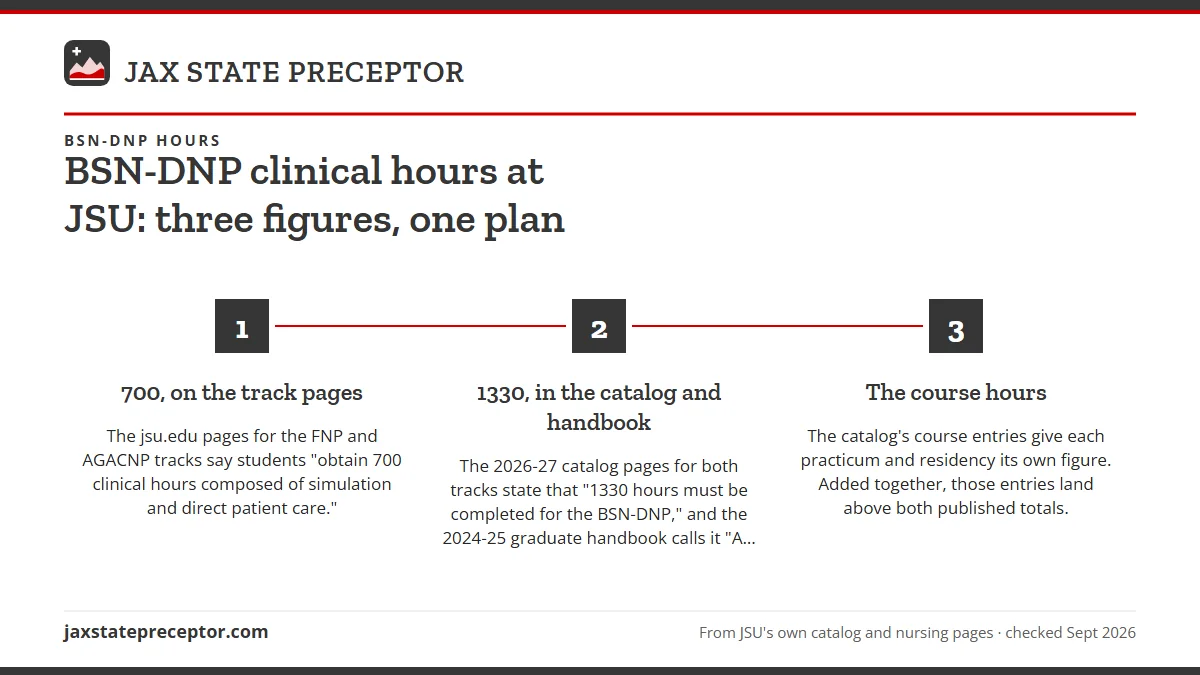
The three figures and where each one appears
Each figure comes from an official JSU source, and each is current on JSU's site as of September 2026. None of them is a typo you can dismiss on sight, which is why the conflict needs reading rather than guessing.
- 700, on the track pagesThe jsu.edu pages for the FNP and AGACNP tracks say students "obtain 700 clinical hours composed of simulation and direct patient care."
- 1330, in the catalog and handbookThe 2026-27 catalog pages for both tracks state that "1330 hours must be completed for the BSN-DNP," and the 2024-25 graduate handbook calls it "A minimum of 1330 hours."
- The course hoursThe catalog's course entries give each practicum and residency its own figure. Added together, those entries land above both published totals.
Course by course, from the 2026-27 catalog
These are the figures the catalog prints on each clinical course in the two BSN-DNP tracks. Terms follow JSU's plans of study; the NP practicums run four semesters in a row, each taken with its lecture course.
| Term on the plan | FNP course | FNP hours | AGACNP course | AGACNP hours |
|---|---|---|---|---|
| Spring, Year 2 | FNP 7869 Practicum I | 120 | ANP 7869 Practicum I | 70 (plans of study: 110) |
| Summer | FNP 7873 Practicum II | 210 | ANP 7873 Practicum II | 210 |
| Fall | FNP 7875 Practicum III | 250 | ANP 7875 Practicum III | 250 |
| Spring, MSN awarded after | FNP 7877 Practicum IV | 250 | ANP 7877 Practicum IV | 280 |
| Final fall, spring, summer | DNP 8797 to DNP 8799 | 210 each | Same three residencies | 210 each |
DNP 8796 Project Planning and Development sits between the last practicum and the first residency. It carries no listed hours, but it is where the residency pairing and contract paperwork happen; the DNP 8796 guide covers it.
Adding it up: why no total matches
Sum the catalog's four FNP practicums and you reach 830 hours; add the three residencies and the figure becomes 1,460. The AGACNP practicums total 810 by the catalog, or 850 if you use the 110 hours the plans of study give Practicum I, so the full AGACNP sum is 1,440 or 1,480.
None of those sums is 700, and none is 1330. The 700 on the track pages sits below even the practicum hours alone, and the 1330 in the catalog sits below the catalog's own course figures once the residencies are counted.
That arithmetic is ours, not JSU's. JSU has not published a statement reconciling the three figures, so no single number on this page should be read as your settled requirement. What stays steady across every current JSU document is the residency block: three courses at 210 hours each.
Where 700 and 1330 seem to come from
The older numbers line up with the 2024-25 graduate handbook, written under JSU's previous three-digit course numbering. That handbook listed the FNP practicums at 120, 210, 210 and 210 hours, and the AGACNP practicums at 70 simulation hours followed by 210, 210 and 210.
Those AGACNP figures add to exactly 700. Add the three 210-hour residencies and you reach exactly 1330. Both published totals therefore match the older acute care layout, before the catalog raised the third and fourth practicums to 250 and 280. The older FNP layout, by the same method, would have come to 750 practicum hours.
This reading explains the gap; it does not settle it. JSU may count simulation, residency or practicum hours toward its totals in ways it has not published. Treat the pattern as a reason to ask, and put the question to your program coordinator in writing.
Other wrinkles in JSU's hour documents
ANP 7869shows 70 hours in the catalog and the NP timeline, 110 on both AGACNP plans of study, and "70 Clinical Simulation Hours" in the 2024-25 handbook. The AGACNP practicum guide covers that course.- The NP timeline PDF's summer column attaches 210 hours to
FNP 7869. The plans of study and the catalog put those 210 hours onFNP 7873, the summer practicum, so read it as a labeling slip. - The fall-admission plans print the residency block as FNP 8796-8799 or ANP 8796-8799; the catalog uses the DNP prefix. They are the same courses.
- The 2024-25 handbook still uses three-digit numbers such as FNP 669 for the first practicum. Use the four-digit catalog numbers when you talk to faculty.
How to plan around the conflict
- Work from the course figureFor the practicum you are registered in, the 2026-27 catalog entry gives the hour count to plan your preceptor's schedule around.
- Confirm it when the course opensAsk your course faculty in the first week whether that figure stands, and how much of it may be simulation. The FNP Clinical Coordinator or ANP Track Clinical Coordinator can answer track-wide questions.
- Keep your own recordHold a copy of every hour you log, course by course, so a later question about totals can be answered from your own file.
- Ask how the program total is checkedBefore Practicum IV, ask the program coordinator which figure JSU checks at graduation and whether residency hours count toward it.
Why BSN-DNP students plan their hours with us
However your placement comes together at JSU, we match you with a preceptor whose schedule can carry the course you are in, at the hour count the current catalog prints. A preceptor who can host 120 hours in spring may have no room for 250 in fall, so we check capacity for each practicum before anyone commits.
Ahead of each term we pull together the credential and practice facts JSU's reviewers ask about, plus the site information a contract needs, and we check that your compliance tracker and malpractice approval are done before we reach out to any practice. Approval of each preceptor and site stays with JSU's faculty, and the file lands with them in order. The FNP program guide and our process explain more, or tell us your track through the form on this page.
Questions JSU students ask
Is the JSU FNP program 700 or 1330 clinical hours?
Both figures appear in official JSU sources: 700 on the FNP track page and 1330 in the 2026-27 catalog's graduation rule. The catalog's course hours add up to more than either. Plan each term by the course figure and ask the program coordinator which total JSU checks before you graduate.
Why does my AGACNP plan of study show 110 hours for Practicum I?
Both AGACNP plans of study list 110 hours for ANP 7869, while the 2026-27 catalog and the NP timeline list 70, and the older handbook called those 70 simulation hours. The catalog is JSU's current reference, so start there and confirm the figure with your course faculty when the course opens.
Do the DNP residency hours count toward the 1330?
JSU does not break the 1330 figure into parts. The only JSU layout that reaches exactly 1330 is the 2024-25 handbook's AGACNP practicums plus the three 210-hour residencies, which suggests residency hours are included. Treat that as a question for your program coordinator rather than a rule.
Can simulation make up part of my BSN-DNP hours?
JSU's track pages describe the program's clinical hours as a combination of simulation and direct patient care, and the older handbook labeled the first acute care practicum as simulation. How much simulation a given course accepts is not published, so ask the course faculty. The what counts guide covers this in depth.
Which JSU document should I trust for hours?
Start with the 2026-27 catalog, which carries the current course numbers and hours. The plans of study are best for term-by-term timing. The 2024-25 graduate handbook predates the renumbering and some hour increases. For anything the catalog leaves open, your course faculty have the final word.
Related pages
Last checked 2026-09-27
We check these pages against JSU's 2026-27 catalog, nursing handbooks, program pages and licensure disclosures. Your course faculty and your plan of study have the final word.
Whether JSU helps or you start alone, we find the preceptor.
Tell us your JSU program, your next practicum or residency and the town you train near. We find preceptors and sites that fit the course and gather what JSU's faculty need to clear them, early enough for the semester.
- Preceptors matched to the course: family practice across the lifespan, adult-gerontology acute care, DNP residencies
- License, certification and site details ready for JSU's clearance, with your CastleBranch and malpractice items in order
- Across Alabama and in Georgia, Florida, Mississippi and Tennessee
Start your placement plan
Your program, your town and your next clinical semester is all we need to begin.