630 DNP residency hours at JSU, 210 at a time
Every JSU DNP student, Post-Master's or BSN-DNP, finishes with the same three residency courses, Residency I through III (DNP 8797 to DNP 8799), worth 210 hours apiece and 630 together. Those hours carry your DNP project from proposal to results at one clinical site with one preceptor for about 16 months, so who precepts you matters as much as the count.
Get your placement plan
Tell us your JSU program and where you live. A placement advisor replies with the preceptor and site options that fit your JSU course.
Where the 630 comes from
The 2026-27 catalog's Post-Master's DNP page states it plainly: "630 hours must be completed for the Post-Master's DNP." The hours sit in three three-credit courses, Residency I, II and III, and the catalog gives each one 210. Unlike the BSN-DNP totals, this number holds steady in every JSU document that mentions it, from the current catalog back to the older handbook.
BSN-DNP students take the same three residencies after their fourth NP practicum, so the 630 applies to them too. How those hours fit into the BSN-DNP's larger and conflicting totals is covered in the BSN-DNP hours guide.
You may meet older labels. The Post-Master's web page still says DNP 796-799, and the fall-admission BSN-DNP plans print FNP 8796-8799 or ANP 8796-8799. All of these point to the same catalog courses, DNP 8797 through DNP 8799.
What the residency is
The residency is where your DNP project lives. JSU's page for clinical partners invites organizations to engage DNP students "to support quality improvement initiatives," and JSU's clinical timeline for DNP preceptors traces the project from first proposal to final presentation. The pairing itself happens earlier, in DNP 8796; the pairing guide covers that step.
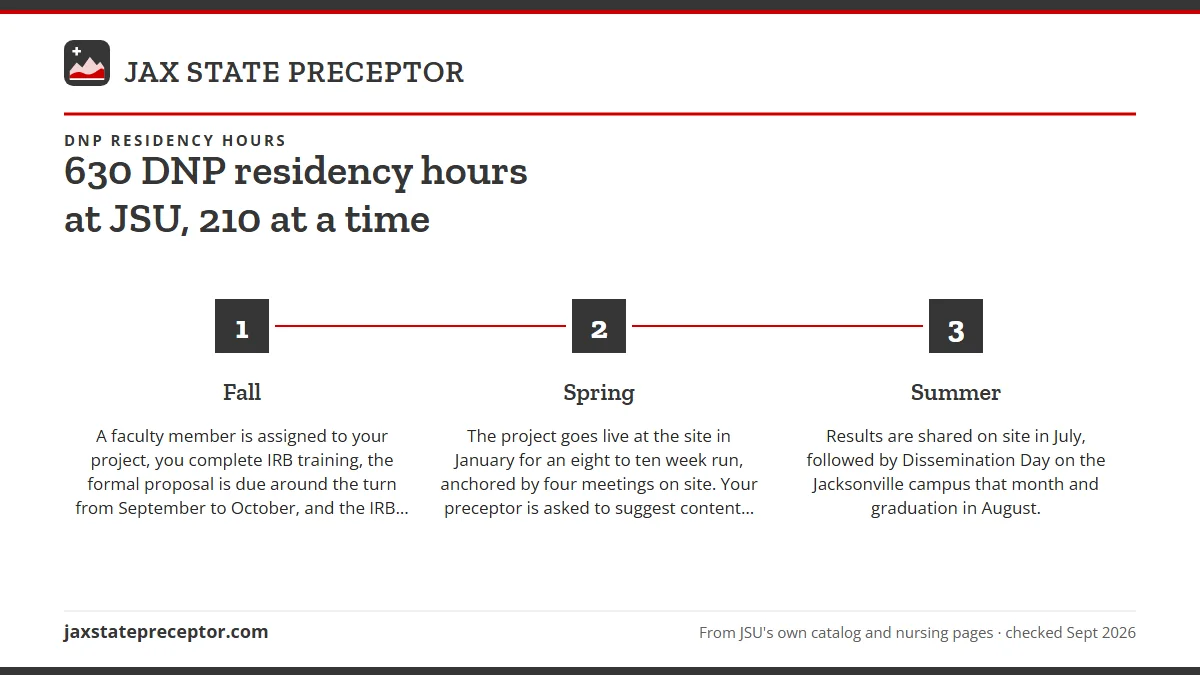
- FallA faculty member is assigned to your project, you complete IRB training, the formal proposal is due around the turn from September to October, and the IRB application goes in during October or November.
- SpringThe project goes live at the site in January for an eight to ten week run, anchored by four meetings on site. Your preceptor is asked to suggest content for the Executive Summary.
- SummerResults are shared on site in July, followed by Dissemination Day on the Jacksonville campus that month and graduation in August.
When the 210-hour blocks fall
JSU's plans of study place each residency in its own semester. The Post-Master's plans differ by admission term; the BSN-DNP plans put the residency year at the very end.
| Plan | DNP 8796 (no hours) | DNP 8797 | DNP 8798 | DNP 8799 |
|---|---|---|---|---|
| Post-Master's, fall admission | Summer, Year 1 | Fall, Year 2 | Spring, Year 2 | Summer, Year 2 |
| Post-Master's, spring admission | Fall, Year 1 | Spring, Year 2 | Summer, Year 2 | Fall, Year 2 |
| BSN-DNP, fall admission | Summer, Year 3 | Fall, Year 4 | Spring, Year 4 | Summer, Year 4 |
The catalog offers Residency I in fall or spring, Residency II in spring or summer and Residency III in summer or fall, which is what lets the two Post-Master's plans run on different clocks. JSU's residency pairing runs on two tracks: the most common one pairs students in late May, and a smaller cohort starts in August.
How the residencies are graded
Residency II and III are graded pass or fail in the catalog, and Residency I's grading basis is left unstated. Under JSU's handbook, a failing mark in a pass or fail course enters your record just like any other F, so a failed residency weighs as much as a failed lecture course.
JSU's catalog also leaves room for DNP 8796, the planning course before the residencies, to be repeated when faculty require it. Because JSU's graduate rules allow only one repeated course, a residency or planning-course problem can quickly become a progression problem. The grades and progression guide explains the repeat and dismissal rules.
Residency problems are easier to solve early. If a site or preceptor issue threatens a residency term, raise it with your DNP Chair and course faculty as soon as it appears.
Before the residency: the 500-hour entry rule
Post-Master's applicants need an MSN "with a clinical focus" backed by 500 verified clinical practicum hours. Applicants may or may not be nurse practitioners; the requirement is the verified hours, not the specialty.
Applicants who fall short are admitted conditionally and take the Advanced Experiential Clinical Course, NU 5841 in the catalog, which asks for somewhere between 100 and 500 clinical hours, the exact figure fixed by a gap analysis. Part of that time can be spent working alongside organizational leaders, according to the catalog. The admission text and web page still call the course NU 531. The NU 5841 guide has the details.
Those MSN or NU 5841 hours are an entry step. The 630 residency hours are earned separately, inside the program.
What a residency preceptor and site commit to
JSU's timeline asks every DNP student to keep the same preceptor and the same clinical site for sixteen months of residency work. That means one person and one organization from the late-May pairing through the July results, across three semesters of hours and a project that needs site approval to run.
In practice, the preceptor meets with you while the project is planned and carried out, weighs in on the Executive Summary, and welcomes the July results presentation at the site. The site needs to be a place where a quality improvement project can actually be carried out and reviewed, and where contract paperwork can be completed when JSU asks for it.
Changes are costly. JSU's handbook routes any change in where you live, work or expect to train through your faculty, your program coordinator and the graduate programs' administrative coordinator; it needs approval, and the handbook warns that progression is not assured afterward.
Why DNP students trust us with the 16-month match
Whatever route leads to your late-May pairing, we look for a preceptor and site that can stay with your project for the whole residency, not just the first term. We ask about project support, leadership access and scheduling across all three semesters before anyone commits.
Before DNP 8796 opens, we have the preceptor's credentials and the organization's contract contacts ready, and your CastleBranch file and malpractice approval cleared, so the late-May paperwork moves without a gap. The School of Nursing's faculty decide on each residency match; we give them a clean, complete packet to decide on. The Post-Master's DNP guide covers the wider program, and the request form on this page reaches our placement desk.
Questions JSU students ask
Can I change residency sites partway through JSU's DNP?
Staying put is the expectation, since JSU wants one preceptor and one site across the residency's sixteen months. A switch counts as a change in projected clinical experience, which has to be reported through JSU's graduate channels and approved, and the handbook cautions that progression can suffer.
Do my MSN clinical hours count toward the 630?
JSU treats them separately. The 500 validated clinical hours from your MSN are an admission requirement for the Post-Master's DNP, and a shortfall is made up in NU 5841 before the program. The 630 residency hours are earned afterward, 210 at a time, in DNP 8797, DNP 8798 and DNP 8799.
Are DNP residency hours spent on direct patient care?
JSU does not describe them that way. Its DNP timeline builds the residency around a quality improvement project that moves from design and ethics review to a winter launch and a summer report. Which activities you may log toward each course's 210 hours is set in the course, so confirm it with your course faculty early.
Does the BSN-DNP have the same residency hours?
Yes. Both BSN-DNP tracks end with the same three residency courses at 210 hours each. On the fall-admission plans, DNP 8796 falls in the summer after the fourth NP practicum, and the three residencies follow in the fall, spring and summer of the fourth year.
When does the 16-month commitment begin?
For most students it begins in late May, inside DNP 8796, when JSU's timeline places the match of student, preceptor and site and the contract paperwork goes in. A smaller cohort starts in August. The commitment runs through the July results and Dissemination Day.
Related pages
Last checked 2026-09-27
We check these pages against JSU's 2026-27 catalog, nursing handbooks, program pages and licensure disclosures. Your course faculty and your plan of study have the final word.
Whether JSU helps or you start alone, we find the preceptor.
Tell us your JSU program, your next practicum or residency and the town you train near. We find preceptors and sites that fit the course and gather what JSU's faculty need to clear them, early enough for the semester.
- Preceptors matched to the course: family practice across the lifespan, adult-gerontology acute care, DNP residencies
- License, certification and site details ready for JSU's clearance, with your CastleBranch and malpractice items in order
- Across Alabama and in Georgia, Florida, Mississippi and Tennessee
Start your placement plan
Your program, your town and your next clinical semester is all we need to begin.