The RN license JSU expects, and where the wording differs
Every JSU graduate nursing program and the STEP RN-BSN require a current, unencumbered registered nurse license, kept that way for the whole program. The sources disagree on where the license must be held: JSU's program pages say the United States, while the 2026-27 catalog's DNP pages say the state where you practice clinically. Here is each version, how the Nurse Licensure Compact changes the picture and who settles the question for you.
Get your placement plan
Tell us your JSU program and where you live. A placement advisor replies with the preceptor and site options that fit your JSU course.
Who needs an RN license at JSU
Every post-licensure nursing program at JSU starts from an RN license. The BSN-DNP FNP and AGACNP tracks, the Post-Master's DNP, the MSN in Population Health, the Graduate Certificate in Nursing Education and the STEP RN-BSN all list a current, unencumbered RN license among their admission requirements. The traditional BSN is the exception, since it prepares students for first licensure.
Admission is only the start. The 2024-25 graduate handbook asks for "proof of current, unencumbered registered nurse licensure throughout," so the license has to stay in good standing for every term you are enrolled. The STEP handbook makes the same point for RN-BSN students, who must keep an active, unencumbered U.S. license.
Your license is also a CastleBranch item. The CastleBranch guide shows where it sits among the other compliance records.
Two wordings for one requirement
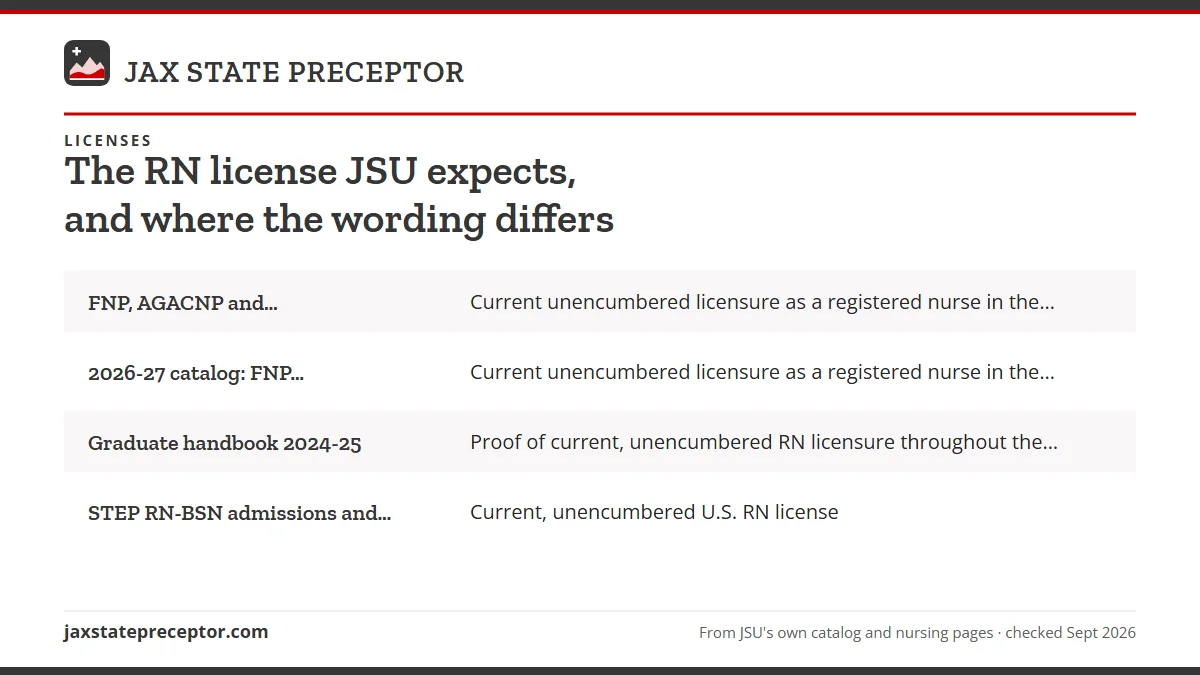
JSU describes the license in two different ways depending on which document you open. The table puts them side by side.
| Source | Wording |
|---|---|
| FNP, AGACNP and Post-Master's DNP web pages | Current unencumbered licensure as a registered nurse in the United States |
| 2026-27 catalog: FNP, AGACNP and Post-Master's DNP | Current unencumbered licensure as a registered nurse in the student's current state of clinical practice |
| Graduate handbook 2024-25 | Proof of current, unencumbered RN licensure throughout the program |
| STEP RN-BSN admissions and handbook | Current, unencumbered U.S. RN license |
The catalog wording is the more specific of the two and sits in the newer document, so read the requirement through it first. If your case falls between the two wordings, ask your track's program coordinator, whose reading settles it.
When the difference matters
For most students the two wordings lead to the same place. If you live in Alabama, hold an Alabama or multistate license and do your clinicals in Alabama, both versions are met.
The gap shows up when your license state and your clinical state differ. A Georgia resident planning clinicals in Georgia, a Tennessee nurse with a practicum across the state line in Alabama, or a student who moves partway through the program all need to know that the license covers the state where patient care happens. The catalog's phrase, "current state of clinical practice," points straight at that state.
JSU also tracks where you live and train. Each graduate student signs an out-of-state residence statement at enrollment, and any change of residence, employment or projected clinical experience goes to the faculty, the program coordinator and the Administrative Coordinator, Graduate Programs, for approval. JSU warns that such a change can affect progression. The five-state rule for the NP tracks is covered on our admission states guide.
The Nurse Licensure Compact across JSU's five NP states
The NP tracks consider residents of Alabama, Georgia, Florida, Mississippi and Tennessee, and every one of those states is a compact member. NCSBN's table shows Georgia, Florida, Mississippi and Tennessee operating under the compact since January 19, 2018, with Alabama joining on January 1, 2020.
With a multistate license from the compact state you call home, RN work across the other member states is covered. The Alabama Board of Nursing applies that to nurses arriving from elsewhere: a valid multistate license from another compact state means no separate Alabama RN license is needed to work in Alabama, unless Alabama is where the nurse primarily lives.
Two cautions apply. The compact covers only RN and LPN licenses held as multistate licenses, so a single-state license does not travel. And as the Alabama board's wording shows, your primary state of residence decides which board's license you need, so talk to your board of nursing and to JSU before you relocate, not after. The Georgia state guide covers one neighboring state in detail.
Your license during the program
Clinical clearance at JSU reaches past a criminal search. The handbook requires students to clear healthcare licensing or certification registries and state boards of nursing before any patient contact, which means your board record is part of the clearance, not a separate formality. Our background check guide covers the rest of that process.
Treat renewal dates as clinical deadlines. A license that lapses during a term breaks the handbook's "throughout" rule, and it puts every clinical hour in that term at risk. Renew early, upload the new record to the tracker straight away, and tell the School of Nursing promptly if anything about your license status changes.
If your employer verifies your license for work, that does not replace JSU's own record. Keep both current.
After JSU: from RN license to CRNP approval
Your RN license stays at the center after graduation. To practice as a certified registered nurse practitioner in Alabama, a new graduate needs an Alabama or multistate RN license, graduate APRN education, national NP certification, continuing education in collaborative practice and a protocol with each collaborating physician. A new graduate may work for as long as six months under provisional approval, using the title Graduate Registered Nurse Practitioner.
The compact stops at the RN level. The Alabama Board of Nursing is clear that advanced practice nurses whose multistate RN license comes from another compact state still have to apply to the Alabama board before practicing at the advanced level. The board has also posted a paper-application process for advanced practice approvals after a cybersecurity event, so check its advanced practice page for current steps. Our Alabama NP practice guide sets out how collaborative practice shapes who can precept.
How we match sites to your license
Jax State Preceptor starts every search with your license and your home address. Our search targets preceptors and sites located where your license already covers clinical practice, which satisfies both of JSU's wordings at once, and we flag early if a promising site sits across a state line your license does not cover.
On the other side of the match, we verify the preceptor's license, board certification and practice setting before JSU sees a thing, so faculty review clean records for both people. Whether JSU helps arrange your placement or not, we find a preceptor and site that meet its rules. Faculty at JSU sign off on each match, and the license facts they review arrive from us already checked. For the state-by-state view of JSU's disclosures, see our licensure disclosure guide.
Questions JSU students ask
Must my RN license come from Alabama for a JSU NP track?
Not necessarily. JSU's program pages ask for an unencumbered RN license in the United States, while the 2026-27 catalog asks for one in your current state of clinical practice. A license valid where your clinicals happen, including a multistate compact license, fits both. Confirm your case with your track's program coordinator.
Does a compact license work for JSU clinicals in Georgia?
Georgia and Alabama are both compact members, which means a multistate license from your home compact state lets you work as an RN in Georgia. That lines up with the catalog's rule that your license cover your state of clinical practice. A single-state license from outside Georgia would not, so check which type you hold.
Does the STEP RN-BSN require a U.S. RN license?
Yes. STEP admission calls for an RN license from a U.S. state that is current and unencumbered, and the STEP handbook requires students to keep an active, unencumbered license while enrolled. The STEP clinical course is NU 456, and non-Alabama residents are asked to contact the School of Nursing before applying. See the STEP RN-BSN guide.
I am moving during my JSU program. What does JSU need?
Tell JSU before you move. The graduate handbook requires students to report a change of residence, employment or projected clinical experience to the faculty, the program coordinator and the Administrative Coordinator, Graduate Programs, and the change must be approved. JSU warns that progression can be affected, and your license must cover your new clinical state.
Will a compact license let me work as an NP in Alabama after JSU?
Not by itself. The compact reaches RN and LPN multistate licenses only. Per the Alabama Board of Nursing, an advanced practice nurse whose multistate RN license was issued by another compact state must still seek Alabama's advanced practice approval, and CRNP practice in Alabama also needs national certification and a collaborative practice protocol.
Related pages
Last checked 2026-09-27
We check these pages against JSU's 2026-27 catalog, nursing handbooks, program pages and licensure disclosures. Your course faculty and your plan of study have the final word.
Whether JSU helps or you start alone, we find the preceptor.
Tell us your JSU program, your next practicum or residency and the town you train near. We find preceptors and sites that fit the course and gather what JSU's faculty need to clear them, early enough for the semester.
- Preceptors matched to the course: family practice across the lifespan, adult-gerontology acute care, DNP residencies
- License, certification and site details ready for JSU's clearance, with your CastleBranch and malpractice items in order
- Across Alabama and in Georgia, Florida, Mississippi and Tennessee
Start your placement plan
Your program, your town and your next clinical semester is all we need to begin.