How Alabama's NP rules shape your preceptor
In Alabama, a nurse practitioner practices in collaboration with a physician under rules the nursing and medical boards write together. That arrangement shapes the clinicians who precept JSU students, the approval you will seek after graduation and even which rural preceptors can claim a state tax credit.
Get your placement plan
Tell us your JSU program and where you live. A placement advisor replies with the preceptor and site options that fit your JSU course.
Collaboration rather than independent practice
Every Alabama nurse practitioner practices inside a formal collaboration with a physician. AANP's fact sheet for the state files Alabama under reduced practice and points out that two regulators share oversight of NPs: the nursing board and the state's medical examiners board.
Collaboration in Alabama is looser than a physician standing in the exam room. The nursing board's collaborative practice chapter, 610-X-5, calls for medical oversight and direction under both boards' rules while leaving out any general demand for direct, on-site supervision. In day-to-day terms, the physician can be across town rather than down the hall. The collaborating physician files a Commencement of Collaborative Practice with the medical board, and the CRNP prescribes under a signed protocol, drawing on a formulary the two boards set together.
The Joint Committee and the 2026 rule changes
Most of this comes from a Joint Committee of the two boards, which recommends the regulations, the model practice protocols and the prescribing formulary. When you read about the limits of an Alabama NP's authority, that committee is usually where the rule began.
The rule book itself moved in January 2026. As of January 10 of that year, the qualification and application rules for CRNPs live in their own chapter, 610-X-9, and 610-X-5 was revised on the same date, which leaves any older citation of section .03 in the collaborative practice chapter out of date. The new chapter also holds the provisional approval rule for new graduates covered below. If a preceptor or a textbook cites a rule number, check it against the Alabama Administrative Code as it currently reads.
What collaboration means for the clinician teaching you
Every Alabama CRNP who precepts you works inside a protocol with a collaborating physician. Newer CRNPs get extra structure. Until a CRNP has logged two years of collaboration, counted as 4,000 hours, the collaborating physician has to be on hand for a tenth or more of the CRNP's scheduled time, and the pair meet quarterly and share quality-assurance work. One physician can collaborate for up to 360 hours a week, the equivalent of nine full-time clinicians.
For you, that structure shows up in how a practice runs, which procedures the preceptor's protocol covers and who reviews charts. Alabama's education rules cast a wide net for advanced practice preceptors, too: an APRN qualifies, and so can a physician or another clinician with the right license who serves the population the course covers. JSU's own criteria for NP preceptors are not public; the preceptor requirements guide covers what JSU does say.
Your RN license and the compact
Alabama has taken part in the Nurse Licensure Compact since January 1, 2020. According to the Board of Nursing, an RN whose multistate license comes from a different compact state can work in Alabama on that license, unless Alabama is where the nurse primarily lives.
The compact covers the RN license and nothing above it. The board is clear that an APRN relying on an out-of-state multistate RN license must still seek Alabama's own advanced practice approval before working as a nurse practitioner here. For JSU students living in a neighboring state, that matters twice: during clinicals now, where JSU's wording on which state's RN license you need is worth confirming with the program, and again after graduation if you plan to practice in Alabama.
After graduation: CRNP approval
Working as a CRNP in Alabama takes Board of Nursing approval, and a new JSU graduate applies with:
- An Alabama or multistate RN license
- Completion of a graduate program that prepares advanced practice nurses
- National certification as a nurse practitioner
- Continuing education in collaborative practice
- A signed protocol with each collaborating physician
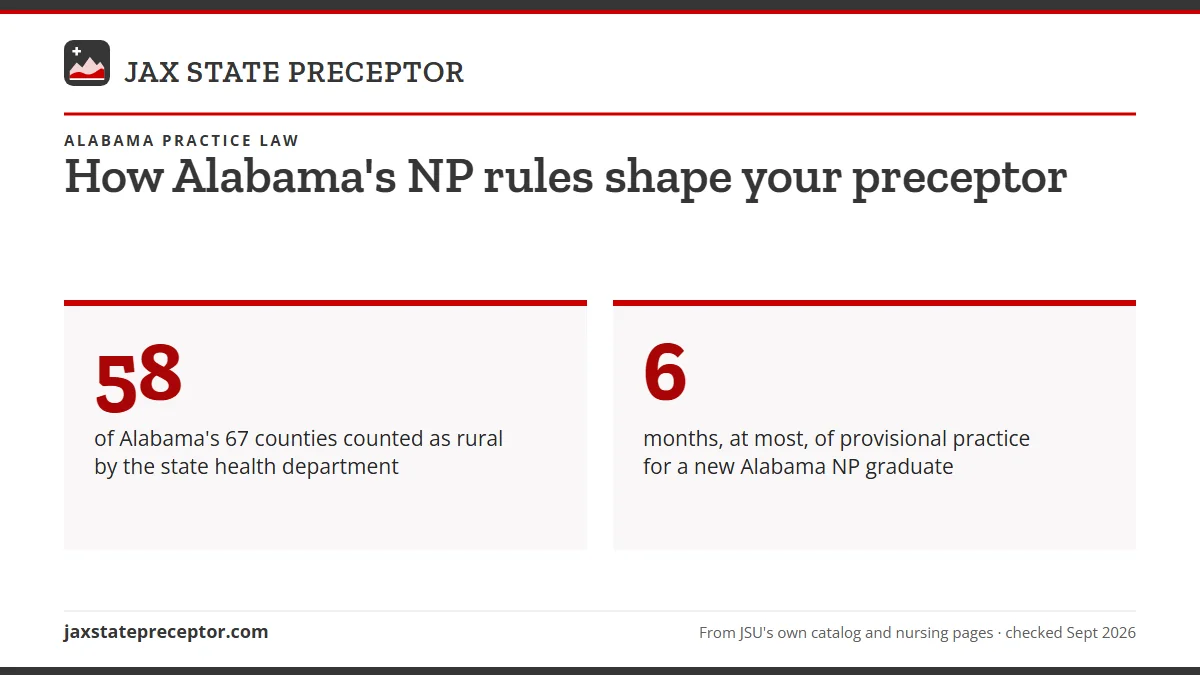
Between graduation and full approval, Alabama offers a temporary status, Graduate Registered Nurse Practitioner, that lasts six months at most and comes with on-site supervision and a review of every patient case. After a cybersecurity event at the board, it set up a paper application process for initial advanced practice approvals, reinstatements and new collaborations, and that notice was still posted in late September 2026.
Alabama's preceptor tax credit
Alabama's Preceptor Tax Incentive Program lets eligible community preceptors, nurse practitioners among them, take a credit against state income tax for the rotations they teach. The Department of Revenue says the credit began with tax year 2024 and ends on September 29, 2031, and the state's AHEC program office, based at UAB, handles the day-to-day administration.
Two conditions decide who benefits. Rotations count only when they happen in a medically underserved rural part of Alabama, and only when the student's school has a physical home inside the state. JSU is an Alabama program, so its rural preceptors sit on the right side of that line, while preceptors teaching for online programs based elsewhere fall outside it. Whether JSU has registered with the AHEC office is unpublished, and preceptors confirm the remaining conditions on the AHEC and Department of Revenue pages.
Where preceptors practice across the state
Access, more than headcount, is the Alabama story. The state health department counts 58 of the 67 counties as rural, and HRSA lists primary care shortage designations across the northeast, including Calhoun, Etowah, Talladega and Cleburne counties. Two counties in that region, Cleburne and Coosa, have no hospital listed in the Alabama Hospital Association directory. For a student, that can mean a longer search and a longer drive to the practice whose patients fit the course.
Health systems and practice patterns differ from one corner of the state to the next. Our regional guides cover Anniston and Gadsden, Birmingham, Huntsville, Montgomery, Mobile and Tuscaloosa, and the Alabama state guide covers the rest. Wherever you live, we look for preceptors whose practice structure and patient mix fit your JSU course.
Questions JSU students ask
Does an Alabama nurse practitioner need a physician on site to precept a student?
Generally, no. Alabama's collaborative practice chapter asks for physician oversight and direction rather than a physician in the room. The main exception involves newer CRNPs, whose collaborating physician must be on hand for at least one-tenth of the hours they are scheduled to work during their first two years. Your preceptor supervises you directly, and JSU's course faculty set the expectations for your practicum.
Can a physician precept a JSU nurse practitioner student in Alabama?
As far as Alabama's rules go, yes. The state's education rules name physicians, along with APRNs and other properly licensed clinicians in the matching population, as eligible preceptors for advanced practice students. JSU keeps its own NP preceptor criteria off its public pages, so confirm with your course faculty before settling on a physician preceptor for a given practicum.
Will my compact RN license from home work for Alabama clinicals?
If it is a multistate license issued by another compact state, the Alabama Board of Nursing accepts it for RN work in Alabama, except when Alabama is your primary residence. JSU's catalog ties its DNP license requirement to the state of your clinical practice, so check your own case with the program.
Who runs Alabama's preceptor tax credit?
Alabama's statewide AHEC office runs the program day to day, and the Department of Revenue posts the credit's terms. The AHEC center closest to JSU is East Central Alabama AHEC in Gadsden. Preceptors check their own eligibility, including the rural-area condition, directly with the program office.
What is a Graduate Registered Nurse Practitioner in Alabama?
It is the stopgap title Alabama gives a new nurse practitioner graduate awaiting full approval. The holder may practice for no more than six months, supervised on site, with each patient case reviewed. The Board of Nursing's rule 610-X-9-.17 sets its terms, and full CRNP approval requires national certification and a collaborative practice protocol.
Related pages
Last checked 2026-09-27
We check these pages against JSU's 2026-27 catalog, nursing handbooks, program pages and licensure disclosures. Your course faculty and your plan of study have the final word.
Whether JSU helps or you start alone, we find the preceptor.
Tell us your JSU program, your next practicum or residency and the town you train near. We find preceptors and sites that fit the course and gather what JSU's faculty need to clear them, early enough for the semester.
- Preceptors matched to the course: family practice across the lifespan, adult-gerontology acute care, DNP residencies
- License, certification and site details ready for JSU's clearance, with your CastleBranch and malpractice items in order
- Across Alabama and in Georgia, Florida, Mississippi and Tennessee
Start your placement plan
Your program, your town and your next clinical semester is all we need to begin.